- 4.9/5.0
- 72 Questions
- Updated on: 12-Oct-2026
- Enterprise Routing and Switching - Professional (JNCIP-ENT)
- 172+ Prepared
- Valid Worldwide
Free JN0-650 Practice Test Questions | Know You're Ready for Enterprise Routing and Switching - Professional (JNCIP-ENT)
This isn't guesswork. It's a mirror of the real Enterprise Routing and Switching - Professional (JNCIP-ENT) exam. Our free JN0-650 practice test questions reveals exactly what you know, what you don't, and what you need to drill before exam day. No surprises. No outdated Enterprise Routing and Switching - Professional (JNCIP-ENT) exam questions. Just a clear path to your Juniper certification.
Click the Exhibit button.
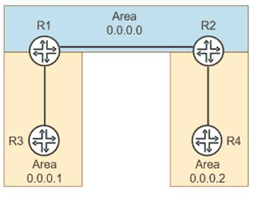
You are troubleshooting suboptimal routing in an enterprise OSPFv2 deployment:
-- R1 is an ABR between Area 0 and Area 1.
-- R2 is an ABR between Area 0 and Area 2.V
-- R3 in Area 1 advertises a network that should be reachable by routers in Area 2.
-- The ABRs are connected in the backbone (Area 0).
On router R2, the show ospf database does not display router LSAs or network LSAs from
Area 1, but an interarea route to R3’s network exists in the routing table. R2 does not have
Type-1 or Type-2 LSAs from Area 1 in its OSPF database.
Referring to the exhibit, which statement is correct?
A. R2 is filtering them using the OSPF import policy.
B. Junos disables Type-1 and Type-2 LSAs by default in Interarea LSDBs.
C. R2 is running OSPFv3, which does not use Type-1 or Type-2 LSAs.
D. Type-1 and Type-2 LSAs are summarized into Type-3 LSAs by ABRs and do not cross area boundaries.
Explanation:
In OSPFv2, Type‑1 (router LSA) and Type‑2 (network LSA) are area‑scoped—they never leave the area in which they originate. When an ABR (like R2) connects Area 0 to Area 2, it does not forward Type‑1 or Type‑2 LSAs from Area 1 into Area 0 or Area 2. Instead, the ABR (R1) in Area 1 summarizes those intra‑area routes into Type‑3 (summary LSA) and floods them into the backbone Area 0. R2 receives those Type‑3 LSAs from Area 0 and installs them as inter‑area routes. This explains why R2 has an inter‑area route to R3’s network but has no Type‑1/Type‑2 LSAs from Area 1 in its database.
Why other options are incorrect:
A. R2 filtering via import policy
– Possible in principle, but the question describes standard OSPF behavior, not a configured filter. No evidence of policy exists.
B. Junos disables Type‑1/Type‑2 LSAs by default
– False. Junos follows standard OSPF; Type‑1/Type‑2 never cross areas by protocol design, not by a disable feature.
C. R2 running OSPFv3
– The question states OSPFv2 deployment. OSPFv3 also does not flood Type‑1/Type‑2 across areas, so this would not explain the symptom.
References:
RFC 2328 (OSPFv2) – Section 3.3: Type‑1 and Type‑2 LSAs are flooded only within their originating area.
Juniper TechLibrary: OSPF Area Types – “ABRs convert intra‑area routes to Type‑3 LSAs for other areas.”
Exhibit
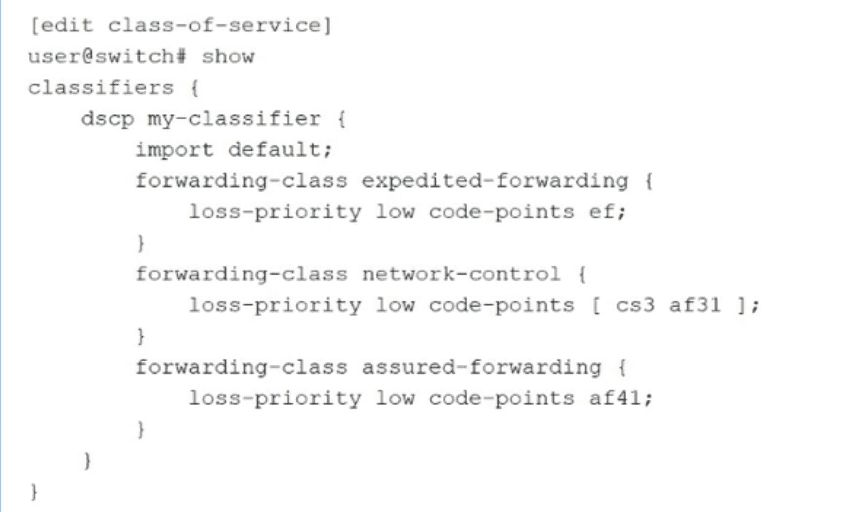
As shown in the exhibit, you have implemented CoS classifiers using Differentiated
Services Code Point (DSCP)
In this scenario, which two statements are correct? (Choose two.)
A. This custom DSCP classifier must be associated with logical interfaces.
B. This custom DSCP classifier must be associated with physical interfaces.
C. The configuration imports all default classification assignments that are not specified.
D. The default classification assignment overwrites all specified classifications
C. The configuration imports all default classification assignments that are not specified.
Explanation:
A. This custom DSCP classifier must be associated with logical interfaces.
– Correct. In Junos CoS, after defining a classifier (like my-classifier), you must explicitly associate it with a logical interface using the classifiers statement under [edit class-of-service interfaces
C. The configuration imports all default classification assignments that are not specified.– Correct. The import default; statement in the classifier configuration explicitly imports the system’s default DSCP classification mapping. Any DSCP value not matched by the user‑defined entries will fall back to the default classification (e.g., best‑effort forwarding class). This ensures complete coverage without needing to redefine every possible code point.
Why B and D are incorrect:
B. This custom DSCP classifier must be associated with physical interfaces.
– Incorrect. Junos attaches classifiers to logical interfaces (unit level), not to physical (ge-, xe-) interfaces directly. Physical interfaces may have multiple logical units, each potentially using a different classifier.
D. The default classification assignment overwrites all specified classifications.
– Incorrect. import default does not overwrite user‑specified entries. Instead, it acts as a fallback: user‑defined code points (like ef, cs3, af31, af41) take priority. If a DSCP value matches a user entry, that mapping is used; otherwise, the default classification applies.
References:
Juniper TechLibrary: “Classifiers – Importing the Default Classifier” – import default adds default mappings as a low‑priority fallback.
Juniper TechLibrary: “Applying Classifiers to Logical Interfaces” – Classifiers are configured under interfaces
Exhibit.
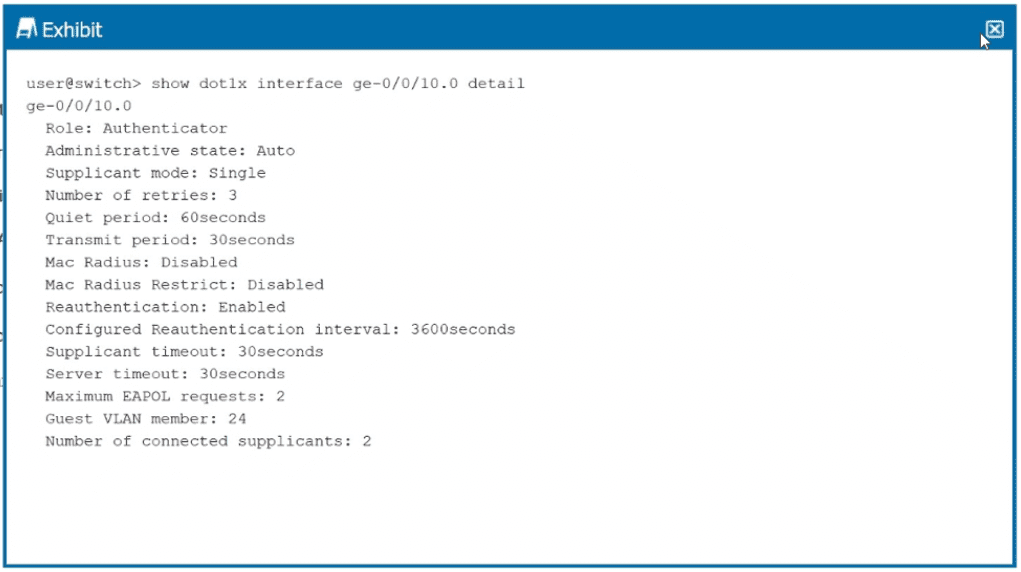
You want to limit port access to only one device at a time.
Referring to the exhibit, which configuration change will accomplish this task?
A. Enable MAC RADIUS restrict.
B. Change the supplicant mode to multiple.
C. Change the supplicant mode to single-secure.
D. Change the maximum EAPOL request to l.
Explanation:
In Junos OS for EX Series switches, the supplicant mode on an 802.1X authenticator interface determines how many devices can connect. To restrict port access to only one device at a time, you must configure single-secure mode.
Per Juniper documentation :
single-secure – Authenticates only one end device to connect to the port. No other device is allowed to connect until the first device logs out. This directly achieves your goal of limiting port access to a single device.
Why other options are incorrect:
A. Enable MAC RADIUS restrict
– This forces the interface to use only MAC RADIUS authentication (bypassing 802.1X) but does not limit the number of connected devices. It controls how authentication happens, not how many devices can access the port .
B. Change the supplicant mode to multiple
– This allows multiple devices to connect to the port, with each device authenticated individually. This is the opposite of limiting to one device .
D. Change the maximum EAPOL request to 1
– This controls how many EAPOL (Extensible Authentication Protocol over LAN) request retransmissions are sent before timing out, not the number of devices allowed on the port.
References:
Juniper TechLibrary – "802.1X Authentication: single-secure supplicant allows only one end device to connect to the port"
Juniper Configuration Guide– supplicant (multiple | single | single-secure)
| Page 1 out of 9 Pages |
Why Take This JN0-650 Enterprise Routing and Switching - Professional (JNCIP-ENT) Practice Exam Before the Real Exam?
This free Enterprise Routing and Switching - Professional (JNCIP-ENT) practice test gives you three critical advantages:
- Real format, real pressure – Identical question structure and difficulty to the official exam
- Instant gap detection – You'll know exactly which topics need more attention
- Learn as you go – Every answer includes a clear explanation, so you're studying while testing