- 4.9/5.0
- 96 Questions
- Updated on: 7-Sep-2026
- Service Provider Professional (JNCIP-SP)
- 196+ Prepared
- Valid Worldwide
Free JN0-664 Practice Test Questions | Know You're Ready for Service Provider Professional (JNCIP-SP)
Exhibit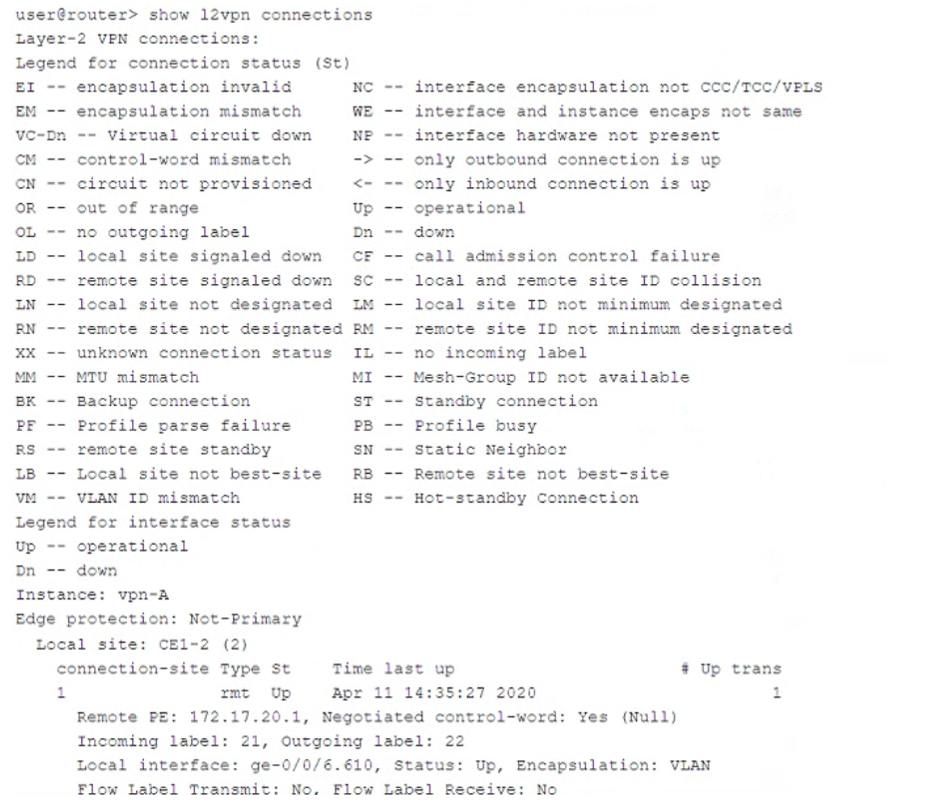
Which two statements about the output shown in the exhibit are correct? (Choose two.)
A. The PE is attached to a single local site.
B. The connection has not flapped since it was initiated.
C. There has been a VLAN ID mismatch.
D. The PE router has the capability to pop flow labels
B. The connection has not flapped since it was initiated.
Explanation:
The show l2vpn connections command provides the status of Layer 2 VPN (Kompella) signaled connections. We can determine the state of the network by analyzing the specific fields in the output:
Single Local Site (Option A):
Under the instance "vpn-A," the output displays Local site: CE1-2 (2). There is only one local site listed in this output, and it has a single remote connection listed below it (Site ID 1). This indicates that this PE is currently servicing only one local site for this specific VPN instance.
Connection Flaps (Option B):
The field # Up trans (Up transitions) indicates how many times the connection has transitioned to the "Up" state. The exhibit shows a value of 1. This means the connection has come up once and remained up; it has not "flapped" (dropped and come back up), which would have increased this counter to 2 or more.
Why Other Options Are Incorrect
C. VLAN ID Mismatch:
The legend indicates that a VLAN ID mismatch would be represented by the code VM. In the connection table, the status is clearly listed as Up, not VM. Furthermore, the local interface ge-0/0/6.610 is shown with a status of Up and encapsulation VLAN, indicating a healthy configuration.
D. Flow Label Capability:
The output explicitly states Flow Label Transmit: No and Flow Label Receive: No. This indicates that Flow Label support (RFC 6391) is either not configured or not supported/negotiated for this specific connection. There is no evidence in the exhibit that the router has the active capability to pop or process flow labels for this circuit.
References
Junos OS VPNs User Guide: "Monitoring Layer 2 VPN Connections" and "Understanding the show l2vpn connections Output."
JNCIP-SP Certification Objectives:"Layer 2 VPNs" – Troubleshooting Kompella L2VPNs and understanding connection status codes.
Click the Exhibit button.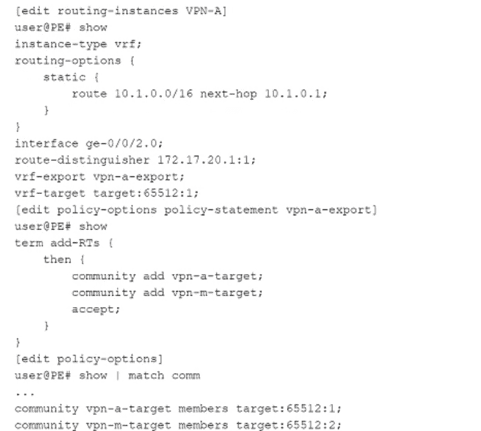
Referring to the exhibit, which statement is correct?
A. VPN routes are exported with the target:65512:1 and target:65512:2 route targets.
B. You cannot use the vrf-target and vrf-export statements in the same VRF.
C. VPN routes with the target:65512:1 and target:65512:2 route targets are imported.
D. VPN routes are exported with only the target:65512:1 route target
Explanation:
The behavior of route targets in this scenario is determined by how Junos prioritizes export policies and the cumulative nature of community additions:
VRF-Target Interaction: The vrf-target target:65512:1 statement acts as a default for both import and export. It automatically applies the target:65512:1 community to routes leaving the VRF.
VRF-Export Policy: When a vrf-export policy is explicitly defined, it processes the routes as they are exported. In the exhibit, the policy vpn-a-export uses the community add command for two distinct communities:
vpn-a-target (which maps to target:65512:1).
vpn-m-target (which maps to target:65512:2).
Resulting Export Path: Because the policy uses community add rather than community set, the communities defined in the export policy are added to any existing communities. Consequently, the exported VPN routes will carry both target:65512:1 and target:65512:2.
Why Other Options Are Incorrect
B: You can absolutely use both vrf-target and vrf-export together. The vrf-target provides a baseline, while vrf-export allows for more granular control or additional target tagging.
C: While routes with target:65512:1 are imported due to the vrf-target statement, there is no vrf-import policy or additional vrf-target statement shown that would trigger the import of routes with target:65512:2.
D: This is incorrect because the vrf-export policy explicitly adds the second target (target:65512:2) via the vpn-m-target community definition.
References
Junos OS VPNs User Guide: "Understanding Route Targets and Export Policies in Layer 3 VPNs".
JNCIP-SP Certification Objectives: Layer 3 VPNs — "Advanced Routing Policy and Route Target Filtering".
Exhibit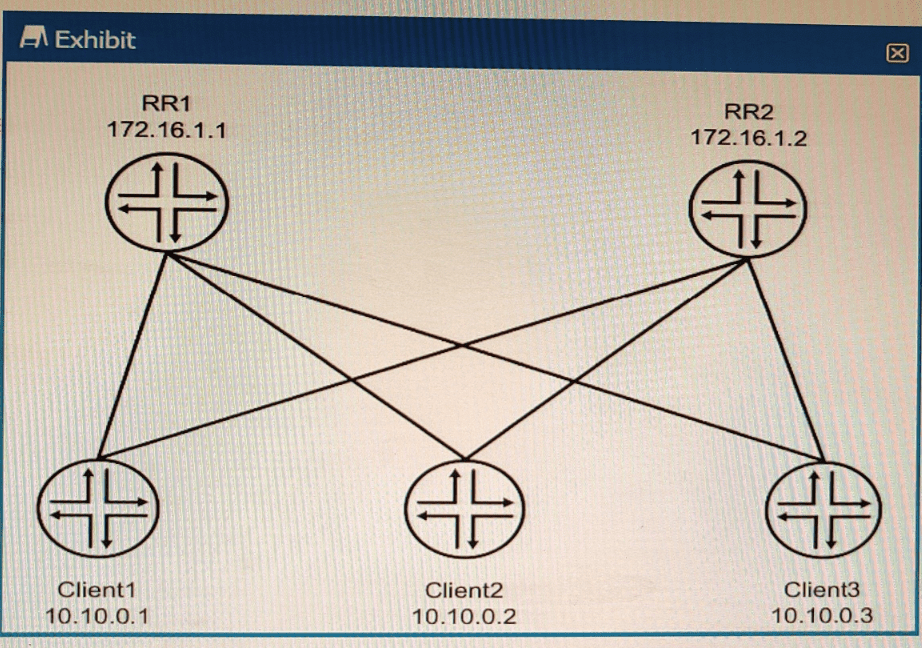
The environment is using BGP All devices are in the same AS with reachability redundancy Referring to the exhibit, which statement is correct?
A. RR1 is peered to Client2 and RR2
B. RR2 is in an OpenConfirm State until RR1 becomes unreachable.
C. Client1 is peered to Client2 and Client3.
D. Peering is dynamically discovered between all devices.
Explanation:
The exhibit illustrates a standard BGP Route Reflection design intended to scale IBGP within a single Autonomous System (AS).
Peering Relationships (Option A):
In a route reflection topology, lines between routers represent BGP peering sessions. The diagram explicitly shows lines connecting RR1 to Client2 and RR1 to RR2. This confirms that RR1 maintains active BGP sessions with both that specific client and its redundant route reflector peer.
Why Other Options Are Incorrect
B. OpenConfirm State:
The OpenConfirm state is a temporary transitional phase in the BGP Finite State Machine (FSM) while waiting for a Keepalive or Notification message. It is not used as a "standby" mechanism for redundancy; BGP neighbors are either established and exchanging routes or they are not. Both RRs should be in an Established state simultaneously.
C. Client-to-Client Peering:
A primary benefit of Route Reflection is that clients do not need to peer with each other. The exhibit confirms this visually; there are no lines connecting Client1 to Client2 or Client3. They learn each other's routes through the RRs.
D. Dynamic Discovery:
Standard BGP requires explicit neighbor configuration (manual peering). While features like BGP Dynamic Neighbors exist (using listen ranges), there is no evidence in this standard architectural diagram to suggest that peering is dynamically discovered rather than manually defined.
References
Junos OS Routing Protocols User Guide: Section on "BGP Route Reflection" and "BGP Peering Sessions."
JNCIP-SP Certification Objectives: "BGP Scaling" – Understanding Route Reflection and peer relationships.
Exhibit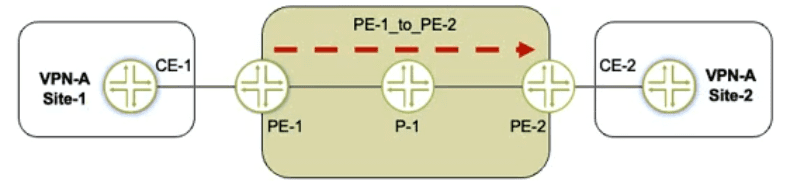
Referring to the exhibit, a working L3VPN exists that connects VPN-A sites CoS is configured correctly to match on the MPLS EXP bits of the LSP, but when traffic is sent from Site-1 to Site-2, PE-2 is not classifying the traffic correctly
What should you do to solve the problem?
A. Configure the explicit-null statement on PE-1.
B. Configure the explicit-null statement on PE-2
C. Configure VPN prefix mapping for the PE-1_to_PE-2 LSP
D. Set a static CoS value for the PE-1_to_PE-2 LSP
Explanation:
In a standard MPLS environment, the default behavior for the penultimate hop (the router before the egress PE) is Penultimate Hop Popping (PHP).
The PHP Problem: By default, the penultimate router (P-1 in the exhibit) removes the outer MPLS transport label before sending the packet to the egress PE (PE-2). When this happens, the EXP bits contained in that transport label are lost.
Impact on Classification: If PE-2 is configured to classify traffic based on the EXP bits of the transport label, it will fail to do so because the packet arrives without that label. It is left to classify based on the remaining inner VPN label or the underlying IP header, which may not align with your CoS policy.
The Solution (Explicit Null): By configuring explicit-null on the egress router (PE-2), you instruct its neighbors (P-1) not to pop the label. Instead, the neighbor replaces the transport label with a reserved Label 0 (IPv4 Explicit Null). This keeps the label stack intact across the final hop, allowing the EXP bits to reach PE-2 so they can be processed by the classifier.
Why Other Options Are Incorrect
A. explicit-null on PE-1:
The explicit-null command must be configured on the router that is the egress for the LSP (the one requesting the label) to influence how its neighbors handle the popping behavior. For traffic Site-1 → Site-2, PE-2 is the egress.
C. VPN prefix mapping:
This is used for mapping specific prefixes to different LSPs or forwarding classes but does not address the fundamental loss of EXP bits due to PHP.
D. Static CoS value:
Setting a static value would ignore the actual markings sent from the customer site, preventing the dynamic end-to-end CoS behavior required in a correctly configured L3VPN.
References
Junos OS Quality of Service User Guide: "Maintaining CoS Markings in MPLS Networks" and "Configuring Explicit Null Labels."
JNCIP-SP Certification Objectives: Under "Class of Service" – Understanding the impact of PHP on EXP-based classification.
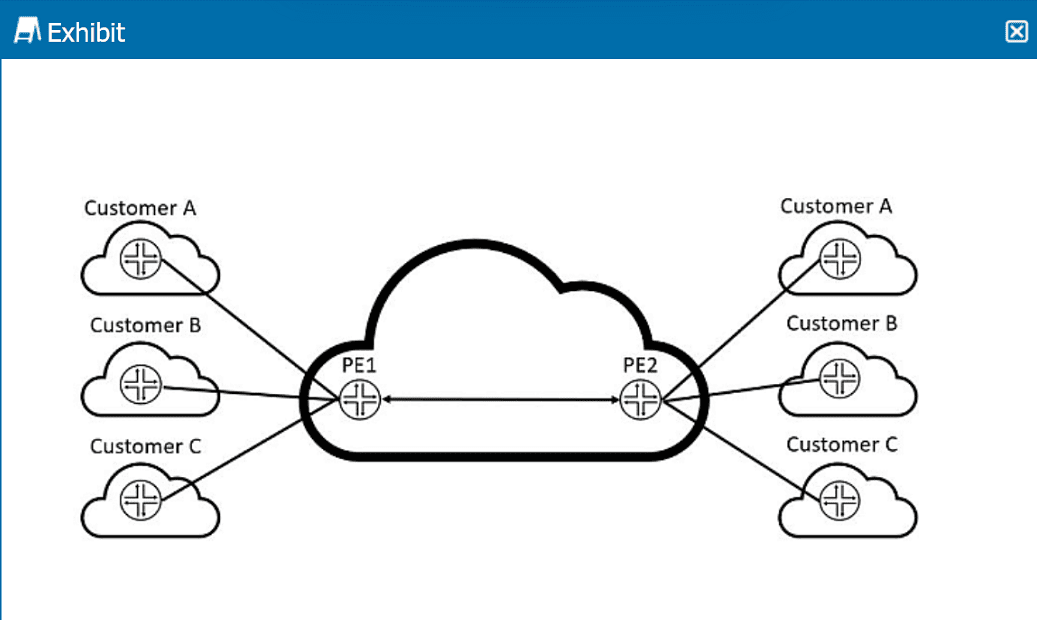 Click the Exhibit button.
After adding Customer C to your Layer 3 VPN, you must ensure that PE2 is receiving VPN routes for all customers attached to PE1, as shown in the exhibit.
Which operational command displays this information?
A. show route table inet.0
B. show route table bgp.l3vpn.0
C. show route table customer-c.inet.0
D. show route summary
Explanation:
In a Juniper MPLS Layer 3 VPN environment, BGP is used to exchange routes between Provider Edge (PE) routers. Understanding how these routes are stored is key to choosing the correct command:
bgp.l3vpn.0 Table: This is the primary routing table on a PE router that stores all incoming VPN-IPv4 routes received via BGP from other PE routers. It contains the 96-bit routes (Route Distinguisher + IPv4 prefix). If you want to ensure PE2 is receiving routes for all customers (Customer A, B, and C) from PE1 in a single view, this is the table to inspect.
Routing Logic:Once a route is in bgp.l3vpn.0, the PE router uses Route Targets to determine which specific customer VRF (Virtual Routing and Forwarding) table the route should be imported into.
Why Other Options Are Incorrect
A. show route table inet.0:
This table contains the PE router's own internal IGP routes and BGP routes for the global Internet. It does not store customer-specific VPN routes.
C. show route table customer-c.inet.0:
While this command would show the routes specifically for Customer C, the prompt asks to verify routes for all customers (A, B, and C) attached to PE1. You would have to run separate commands for every individual VRF, whereas bgp.l3vpn.0 provides a centralized view.
D. show route summary:
This command provides high-level statistics (such as the number of active/holddown routes) for all tables but does not display the actual prefix information needed to confirm specific route receipt.
References
Junos OS VPNs User Guide: "Monitoring Layer 3 VPNs" – Section on viewing the bgp.l3vpn.0 table.
JNCIP-SP Certification Objectives: Under "Layer 3 VPNs" – Troubleshooting BGP route exchange and route table structures.
Exhibit
You have MAC addresses moving in your EVPN environment
Referring to the exhibit, which two statements are correct about the sequence number? (Choose two)
A. It identifies MAC addresses that should be discarded.
B. It resolves conflicting MAC address ownership claims.
C. It helps the local PE to identify the latest advertisement.
D. It is advertised using a Type 2 message
D. It is advertised using a Type 2 message
Explanation:
The exhibit shows a BGP community attribute: mac-mobility:0x0 (sequence 4). This attribute is used to handle MAC mobility events, such as when a virtual machine moves from one host (connected to PE1) to another host (connected to PE2).
Type 2 Advertisement (Statement D):
In EVPN, MAC address reachability is shared via Route Type 2 (MAC/IP Advertisement routes). When a PE learns a new MAC address locally, it advertises this Type 2 route to its peers. If the MAC was previously seen elsewhere, the PE includes the MAC Mobility extended community in that Type 2 update.
Resolving Ownership (Statement B):
The sequence number acts as a "timestamp" or versioning mechanism. When multiple PEs claim to have the same MAC address, the PE with the highest sequence number is considered the current and valid owner of that MAC. This prevents traffic from being sent to an outdated location.
Sequence Incrementing:Every time a MAC moves to a new PE, the new PE increments the sequence number it received from the previous advertisement. In the exhibit, the sequence is currently at 4, indicating the MAC has moved multiple times.
Why Other Options Are Incorrect
A. Identify discarded addresses:
The sequence number is used to determine the correct path for active traffic, not to identify addresses that should be discarded or blackholed.
C. Help the local PE identify latest advertisement:
While the sequence number identifies the latest advertisement for the network, it is the remote PEs (and the overall BGP control plane) that use this to update their tables. The local PE that just learned the MAC simply increments the number and tells the rest of the network it is the new owner.
References
Junos OS VPNs User Guide: "EVPN MAC Mobility Overview" – Section detailing the use of sequence numbers in Type 2 routes.
JNCIP-SP Certification Objectives: Under "Edge-routed Bridging (ERB) and EVPN-MPLS Operations" – MAC mobility and BGP communities.
| Page 5 out of 12 Pages |