- 4.9/5.0
- 96 Questions
- Updated on: 7-Sep-2026
- Service Provider Professional (JNCIP-SP)
- 196+ Prepared
- Valid Worldwide
Free JN0-664 Practice Test Questions | Know You're Ready for Service Provider Professional (JNCIP-SP)
Exhibit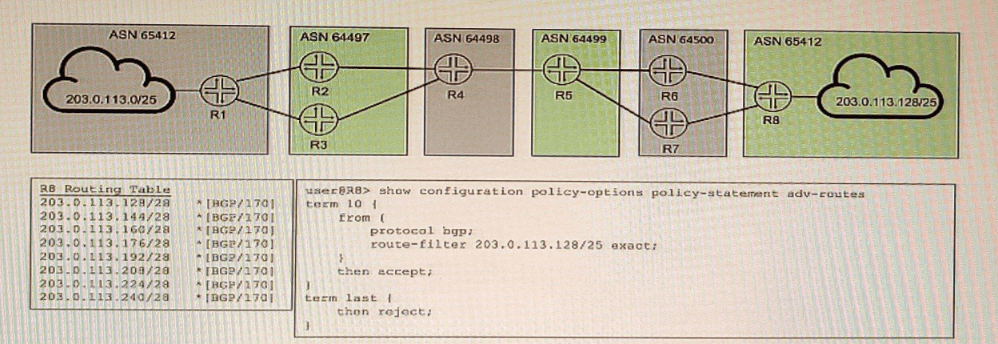
You are attempting to summarize routes from the 203.0.113.128/25 IP block on R8 to AS 64500. You implement the export policy shown in the exhibit and all routes from the routing table stop being advertised.
In this scenario, which two steps would you take to summarize the route in BGP? (Choose two.)
A. Remove the from protocol bgp command from the export policy
B. Add the set protocols bgp family inet unicast add-path command to allow additional routes to the RIB tables. -
C. Add the set routing-options static route 203.0.113.123/25 discard command.
D. Replace exact in the export policy with orlonger.
D. Replace exact in the export policy with orlonger.
Explanation:
The exhibit shows R8 attempting to advertise a summary route 203.0.113.128/25 toward AS 64500. However, the export policy adv-routes contains:
from protocol bgp
route-filter 203.0.113.128/25 exact
After applying this policy, all routes stop being advertised because the policy matches nothing and the final reject blocks everything.
A. Remove the from protocol bgp command from the export policy.
R8 likely does not have a BGP route for 203.0.113.128/25 exactly. The route may be an aggregate, static, or directly connected route. By specifying protocol bgp, the policy matches only BGP-learned routes, excluding other route sources. Removing this allows the policy to match the summary route regardless of its protocol origin (e.g., aggregate or static discard).
D. Replace exact in the export policy with orlonger.
If R8 has only more‑specific routes (e.g., /26, /27, etc.) and no exact /25 route, the exact match fails. Changing to orlonger matches the prefix 203.0.113.128/25 and any more-specific routes. However, for proper summarization, you typically need an aggregate route or static discard route for the /25 itself. The orlonger alone is insufficient without a summary route in the table. But in combination with removing protocol bgp, R8 can generate the summary via an aggregate route. The question asks for two steps to summarize the route — A and D are the correct pair from the options given.
Why other options are incorrect
B. Add add-path command
add-path allows advertising multiple BGP paths for the same prefix. It does not help with route summarization or fix the “no routes advertised” problem.
C. Add static route 203.0.113.123/25 discard
The prefix is incorrect — should be 203.0.113.128/25, not .123/25. Even if corrected, a static discard route alone does not fix the policy match issue without also adjusting the policy.
References:
Junos BGP Configuration Guide:BGP export policies for route summarization. Aggregate routes require orlonger or separate aggregate term. Removing protocol restriction allows non‑BGP routes to be advertised. JNCIP‑SP Study Guide: BGP — Prefix aggregation.
Exhibit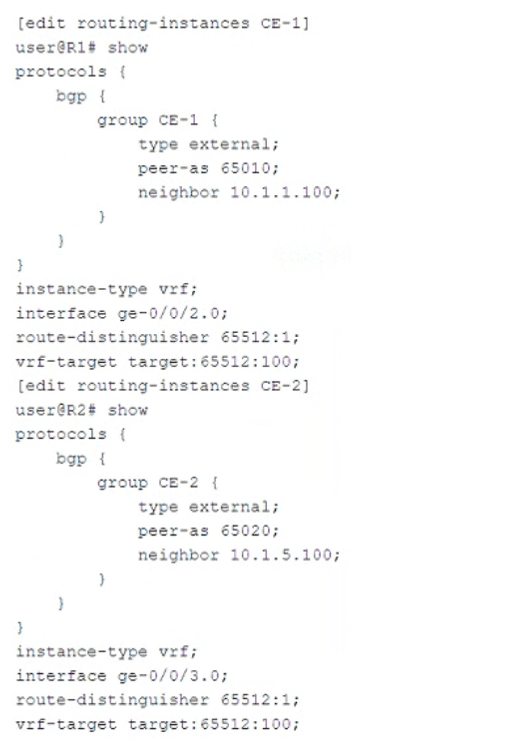
Referring to the exhibit, which statement is correct?
A. The vrf-target configuration will allow routes to be shared between CE-1 and CE-2.
B. The vrf-target configuration will stop routes from being shared between CE-1 and CE-2.
C. The route-distinguisher configuration will allow overlapping routes to be shared between CE-1 and CE-2.
D. The route-diatinguisher configuration will stop routes from being shared between CE-1 and CE-2.
Explanation;
In a Layer 3 VPN environment, the exchange of routes between different routing instances (VRFs) is governed by the BGP community attributes known as Route Targets.
VRF-Target Functionality: The vrf-target command is a shortcut in Junos that simultaneously configures both the export and import targets for a routing instance.
Matching Targets: In the exhibit, both the CE-1 instance and the CE-2 instance are configured with the exact same target: target:65512:100.
CE-1 will export its routes with this community string.
CE-2 is configured to import any routes that carry the target:65512:100 community.
Result: Because the import and export targets match across both instances, the Provider Edge (PE) routers will successfully install and share routes between these two customer sites.
Analysis of Route Distinguishers (RD)
While the exhibit shows both instances using the same Route Distinguisher (65512:1), it is important to note that the RD's primary purpose is to make IP prefixes unique within the BGP table (transforming an IPv4 address into a 96-bit VPN-IPv4 address). While using the same RD in a small environment is possible, it is the VRF-Target, not the RD, that controls the actual sharing (import/export logic) of those routes between instances.
Why Other Options Are Incorrect
B: The configuration will allow sharing, not stop it, because the targets are identical.
C & D: These options incorrectly attribute the sharing logic to the Route-Distinguisher. The RD ensures uniqueness for overlapping address spaces, but it does not dictate which VRF a route is imported into; that is strictly the role of the VRF-Target.
References
Junos OS VPNs User Guide: "Understanding Route Targets" and "Understanding Route Distinguishers."
JNCIP-SP Certification Objectives: Layer 3 VPNs – Route Target and Route Distinguisher operation.
Click the Exhibit button.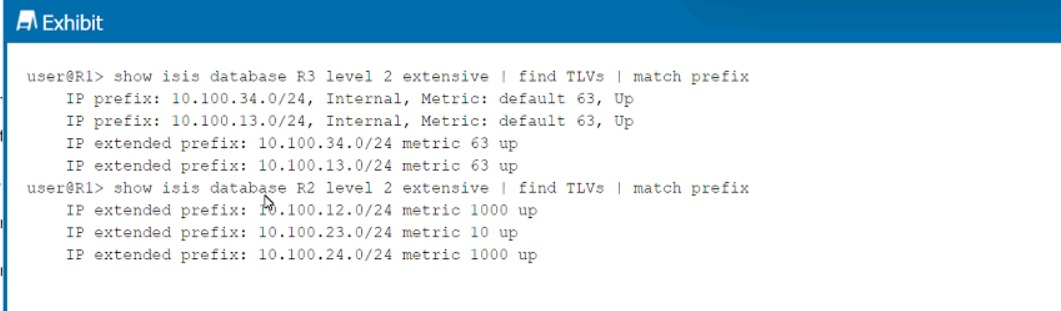
You enabled a new router (R3) in your network but all destinations using IS-IS routes are not properly load balancing over this new router.
Referring to the exhibit, what is the problem?
A. R2 is missing internal routes for R1.
B. R1 is missing internal routes for R2.
C. R3 does not have wide-metrics enabled.
D. R1 does not have wide-metrics enabled.
Explanation:
The exhibit shows a critical mismatch in IS-IS metric types between routers. R3 advertises prefixes with narrow metrics (maximum value 63, as seen with metrics 63 in the output), while R2 uses wide metrics (values up to 1000).
Why other options are incorrect
A. R2 is missing internal routes for R1The output shows R2 advertises extended prefixes (10.100.12.0/24, 10.100.23.0/24, 10.100.24.0/24) successfully. R2 has proper routes.
B. R1 is missing internal routes for R2R1 receives and displays R2's extended prefixes. R1's routing table is populated correctly.
D. R1 does not have wide-metrics enabledR1 successfully processes R2's wide metrics (values up to 1000), proving wide metrics are enabled on R1.
References
ExamTopics JN0-664 Discussion — Most voted answer identifies wide-metrics mismatch
RFC 5305 (IS-IS Extensions for Traffic Engineering) — defines extended TLVs (type 135)
Juniper IS-IS Configuration Guide — wide-metrics-only command
Exhibit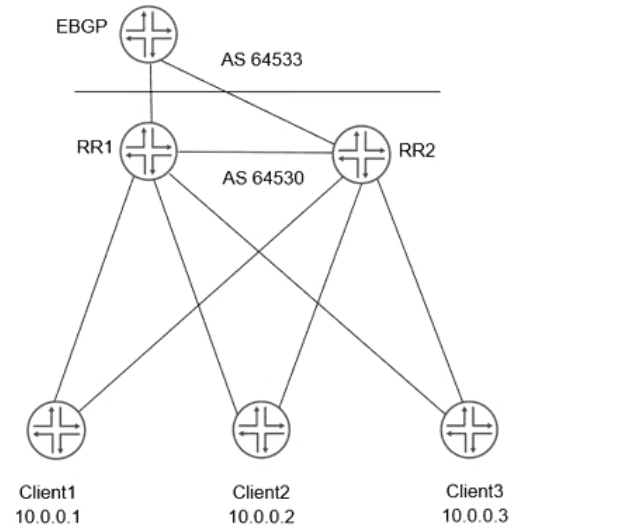
Referring to the exhibit, which two statements are correct about the dual route reflectors within a cluster? (Choose two.)
A. RR1 and RR2 must have the same duster ID to exchange routes learned from the client.
B. RR1 and RR2 append the duster ID when advertising routes from dient to dient.
C. RR1 and RR2 advertise routes learned from the clients to EBGP peers, using itself as the next hop.
D. RR1 advertises routes from the client to RR2. using itself as the next hop.
C. RR1 and RR2 advertise routes learned from the clients to EBGP peers, using itself as the next hop.
Explanation:
Cluster ID and Loop Prevention
CLUST_LIST Attribute (Option B): When a Route Reflector (RR) reflects a route from one client to another client (or to a non-client), it prepends its Cluster ID to the CLUSTER_LIST attribute. This is a fundamental BGP loop prevention mechanism. If an RR receives a route containing its own Cluster ID in the list, it knows a routing loop has occurred and will discard the update.
EBGP Next-Hop Behavior
Next-Hop Self (Option C): Standard BGP rules dictate that when an IBGP router (including RRs) advertises a route to an EBGP peer, it must change the BGP next-hop to its own IP address. This ensures that the external peer knows where to send traffic to reach those internal destinations.
Why Other Options Are Incorrect
A. Cluster ID for RR Exchange:
RR1 and RR2 do not need the same Cluster ID to exchange routes. While they often share one in a redundant cluster to prevent redundant reflection between them, they are standard IBGP peers; they exchange routes based on IBGP peering rules and specific loop prevention checks (Originator ID and Cluster List).
D. IBGP Next-Hop Preservation:
By default, BGP Route Reflectors do not change the next-hop attribute when reflecting routes to other IBGP peers (including other RRs in the same AS). They preserve the original next-hop (e.g., the client's IP) to ensure the path remains optimal and the traffic follows the IGP shortest path.
References:
Junos OS Routing Protocols User Guide: Section on "BGP Route Reflection" and "Next-Hop Resolution."
JNCIP-SP Certification Objectives: "BGP Scaling" – Understanding Route Reflection and Loop Prevention (CLUSTER_LIST and ORIGINATOR_ID).
| Page 4 out of 12 Pages |