- 4.9/5.0
- 96 Questions
- Updated on: 27-Jul-2026
- Service Provider Professional (JNCIP-SP)
- 196+ Prepared
- Valid Worldwide
Free JN0-664 Practice Test Questions | Know You're Ready for Service Provider Professional (JNCIP-SP)
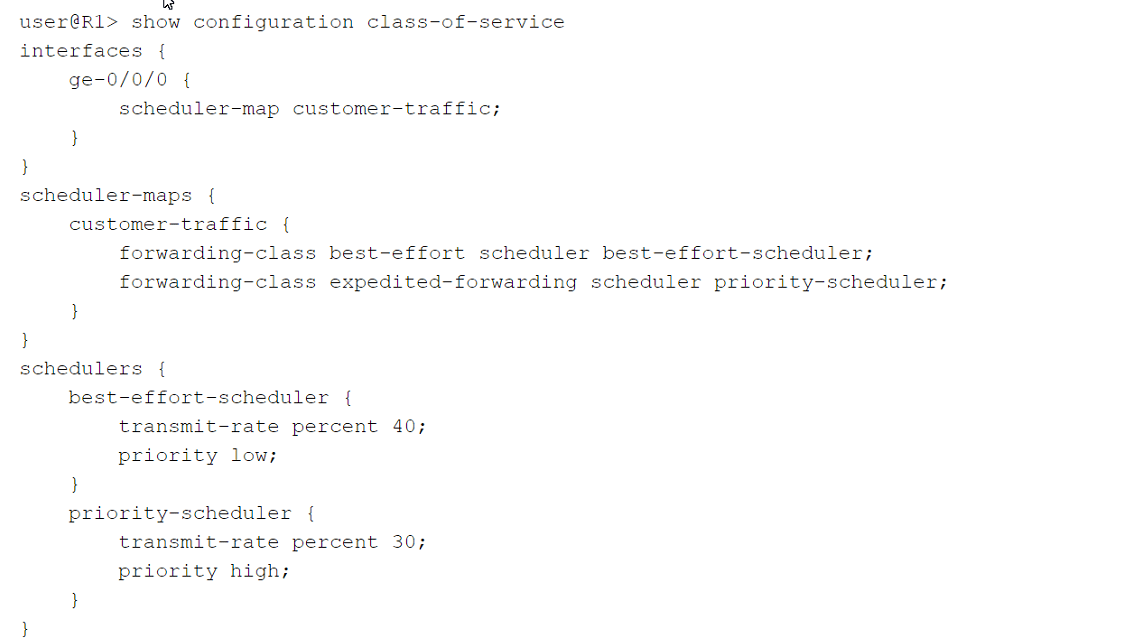
Click the Exhibit button.
Which two statements are correct about the class-of-service configuration shown in the exhibit? (Choose two.)
A. Incoming traffic will not be classified because no classifier exists in the configuration.
B. The best-effort queue can transmit more than 40% of the total bandwidth on the ge-0/0/0 interface, if no other queue is using that bandwidth.
C. Incoming traffic will be classified using the default classifier.
D. The best-effort queue can never transmit more than 40% of the total bandwidth on the ge-0/0/0 interface, even if that bandwidth is available.
C. Incoming traffic will be classified using the default classifier.
Explanation:
The exhibit shows a CoS configuration on interface ge-0/0/0 with a scheduler map customer-traffic. Two forwarding classes (best-effort and expedited-forwarding) are mapped to schedulers with transmit rates of 40% and 30% respectively. No classifier is explicitly configured.
B. The best-effort queue can transmit more than 40% of the total bandwidth on the ge-0/0/0 interface, if no other queue is using that bandwidth.
Correct. The scheduler uses transmit-rate percent 40 without the exact keyword. In Junos, when exact is omitted, the transmit-rate acts as a minimum guaranteed bandwidth. The queue can use additional bandwidth if other queues are not fully utilizing their allocations. The remaining 30% of bandwidth (100% - 40% - 30% = 30%) plus any unused bandwidth from the EF queue becomes available to the best-effort queue.
C. Incoming traffic will be classified using the default classifier.
Correct. No explicit classifier (BA or multifield) is configured under class-of-service interfaces for ge-0/0/0. Therefore, Junos applies the default classifier for the interface type (Ethernet). The default IP precedence classifier maps incoming packets with precedence 0 to best-effort and precedence 5 to expedited-forwarding, etc.
Why other options are incorrect
A. Incoming traffic will not be classified because no classifier exists
Incorrect. Junos always classifies traffic. Without an explicit classifier, the default classifier applies.
D. Best-effort queue can never transmit more than 40% of total bandwidth
Incorrect. Without the exact keyword, the transmit rate is a minimum guarantee, not a maximum limit. The queue can exceed 40% when bandwidth is available.
References:
Junos Class of Service Configuration Guide: Schedulers — transmit-rate without exact guarantees minimum, not maximum. Default classifiers apply when no classifier is configured. JNCIP‑SP Study Guide: CoS — Scheduler behavior and classification defaults.
Exhibit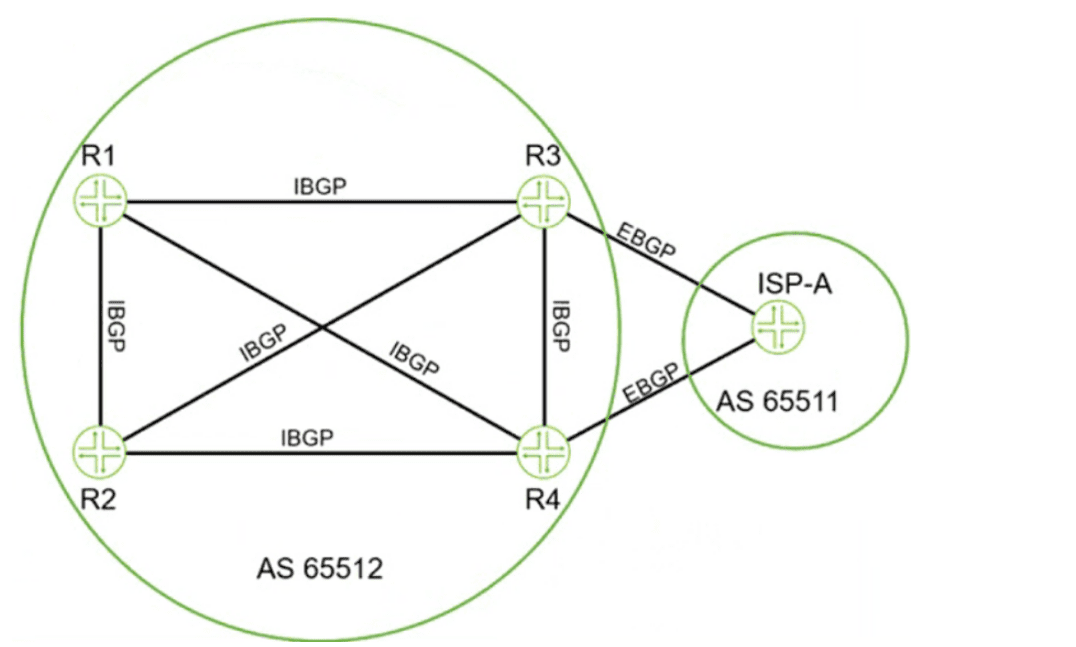
Click the Exhibit button-Referring to the exhibit, which two statements are correct about BGP routes on R3 that are learned from the ISP-A neighbor? (Choose two.)
A. By default, the next-hop value for these routes is not changed by ISP-A before being sent to R3.
B. The BGP local-preference value that is used by ISP-A is not advertised to R3.
C. All BGP attribute values must be removed before receiving the routes.
D. The next-hop value for these routes is changed by ISP-A before being sent to R3.
D. The next-hop value for these routes is changed by ISP-A before being sent to R3.
Explanation:
The exhibit shows an eBGP session between ISP-A (AS 65511) and R3 (AS 65512). R3 is learning routes from ISP-A. Inside AS 65512, all routers have IBGP sessions.
A. By default, the next-hop value for these routes is not changed by ISP-A before being sent to R3.
Correct. In eBGP, the next-hop attribute is set to the IP address of the advertising router's interface that sends the update. However, if the route originated within ISP-A, the next-hop may be the internal router that originated it. More importantly, the statement says "not changed by ISP-A before being sent to R3" — meaning ISP-A does not arbitrarily modify next-hop beyond normal eBGP behavior. By default, ISP-A will set the next-hop to its own interface address (the eBGP neighbor address). But if the route is learned via IBGP inside ISP-A, the next-hop may be preserved. The key point: ISP-A does not perform next-hop-self by default unless configured. Thus, the next-hop value is not changed beyond standard eBGP rules.
B. The BGP local-preference value that is used by ISP-A is not advertised to R3.
Correct. Local preference is a well-known discretionary attribute that is local to an AS. It is not advertised to eBGP neighbors. When ISP-A sends routes to R3, the local-preference value (used internally in AS 65511) is stripped from the update before transmission. R3 will apply its own local preference (default 100) upon receiving the route.
Why other options are incorrect
C. All BGP attribute values must be removed before receiving the routes
Incorrect. Certain attributes (AS_PATH, next-hop, MED, community) are preserved or appropriately modified. Attributes are not "all removed."
D. The next-hop value for these routes is changed by ISP-A before being sent to R3
Incorrect. This is not a default behavior. next-hop-self must be explicitly configured on ISP-A to change the next-hop to its own IP. Without it, the next-hop may remain the internal router's IP (if the route came from IBGP inside ISP-A).
References:
RFC 4271: BGP path attributes — local preference is AS-local and not passed to eBGP peers. Next-hop handling: eBGP sets next-hop to neighbor interface IP unless next-hop-self is configured. Junos BGP Configuration Guide.
Exhibit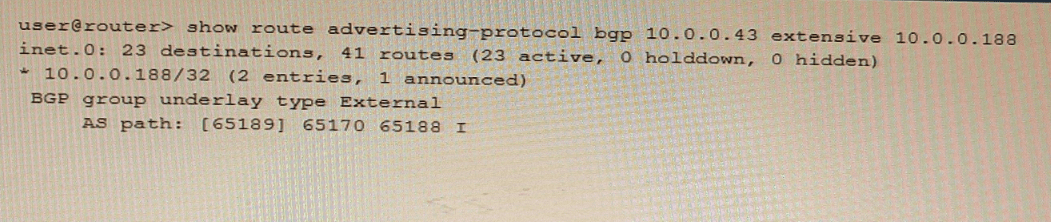
Referring to the exhibit, what do the brackets [ ] in the AS path identify?
A. They identify the local AS number associated with the AS path if configured on the router, or if AS path prepending is configured
B. They identify an AS set, which are groups of AS numbers in which the order does not matter
C. They identify that the autonomous system number is incomplete and awaiting more information from the BGP protocol.
D. They identify that a BGP confederation is being used to ensure that there are no routing loops.
Explanation:
In the exhibit, the AS path is displayed as: [65189] 65170 65188 I
The brackets [ ] in a BGP AS path indicate an AS_SET. An AS_SET is an unordered list of AS numbers that the route has traversed. Unlike a normal AS_SEQUENCE (where order matters and loops are detected by seeing the local AS), an AS_SET treats all listed AS numbers as having been traversed, but without any specific order.
Why other options are incorrect
A. Identify the local AS number associated with the AS path if configured on the router, or if AS path prepending is configured
Incorrect. Local AS or prepended AS numbers appear as normal AS_SEQUENCE elements without brackets.
C. Identify that the autonomous system number is incomplete and awaiting more information
Incorrect. There is no "incomplete" AS path indicator in BGP. The I at the end indicates IGP origin, not incomplete AS info.
D. Identify that a BGP confederation is being used
Incorrect. Confederations use parentheses ( ) for confederation sub-AS numbers, not brackets [ ].
References
RFC 4271: BGP AS_PATH — AS_SET (indicated by brackets) is an unordered set of AS numbers used during route aggregation. Junos BGP Configuration Guide: AS path formatting — [ ] denotes AS_SET. JNCIP‑SP Study Guide: BGP — Path attributes.
Exhibit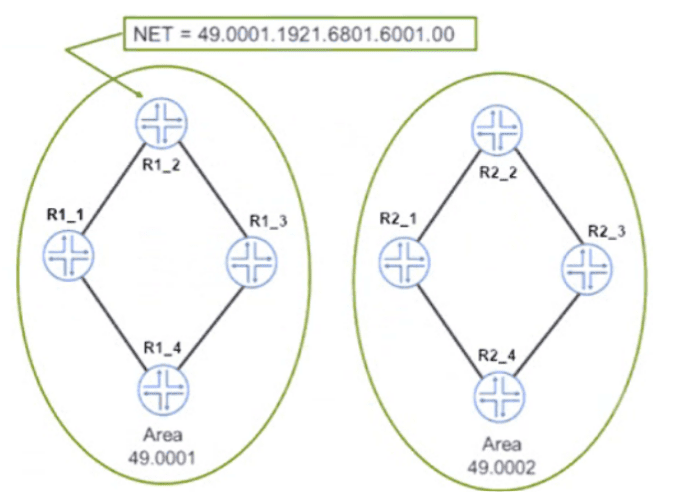
The network shown in the exhibit is based on IS-IS
Which statement is correct in this scenario?
A. The NSEL byte for Area 0001 is 00.
B. The area address is two bytes.
C. The routers are using unnumbered interfaces
D. The system IDofR1_2 is 192.168.16.1
Explanation:
The exhibit shows an IS-IS network with two areas: 49.0001 and 49.0002. The NET (Network Entity Title) for one router is given as: 49.0001.1921.6801.6001.00
A. The NSEL byte for Area 0001 is 00.
Correct. The NSEL (N‑SEL) or SEL (NSAP Selector) is the last byte (two hex digits) of the NET. In IS-IS, the SEL is always 00 for routing purposes. In the given NET 49.0001.1921.6801.6001.00, the final 00 is the NSEL. This identifies the NET as an IS‑IS routing entity rather than a transport layer endpoint. Therefore, the NSEL for Area 0001 (or any area) is indeed 00.
Why other options are incorrect
B. The area address is two bytes.
Incorrect. The area address is variable length. Here, 49.0001 — 49 is the AFI (1 byte), and 0001 is the area ID (2 bytes). Total area address length is 3 bytes, not 2 bytes.
C. The routers are using unnumbered interfaces.
Incorrect. There is no information in the exhibit about interface addressing. IS-IS can run on numbered or unnumbered interfaces, but the exhibit does not indicate either. The NET shows the system ID derived from an IP address (1921.6801.6001 = 192.168.1.1 format), suggesting numbered interfaces exist, but unnumbered is not stated or implied.
D. The system ID of R1_2 is 192.168.16.1.
Incorrect. The system ID in the NET is 1921.6801.6001, which converts to 1921.6801.6001 (hex) → 192.168.1.1 in dotted decimal, not 192.168.16.1. The conversion: 1921=192.1? Actually, standard mapping: 1921 hex = 192.1? Let's clarify: 192.168.1.1 in hex is c0.a8.01.01, not 1921.6801. Wait — the given 1921.6801.6001 is likely a 6‑byte system ID written as 3 groups of 4 hex digits: 1921 6801 6001. This does not directly map to a simple dotted decimal IP. It is not 192.168.16.1. The system ID format is 6 bytes of hex, not directly an IP address. Thus D is false.
References:
ISO 10589: IS-IS NET format — AFI + Area ID + System ID (6 bytes) + SEL (00 for routing). SEL byte is always 00 for IS‑IS routing entities. Junos IS-IS Configuration Guide.
Exhibit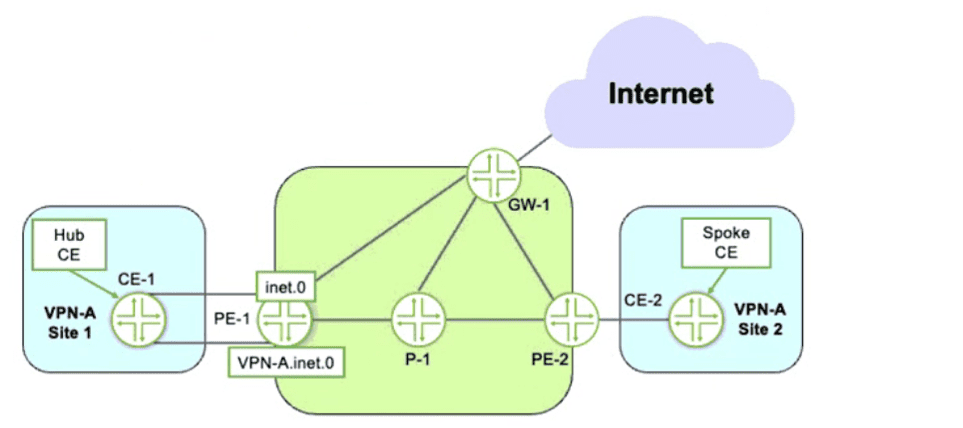
Referring to the exhibit, you must provide Internet access for VPN-A using CE-1 as the hub CE.
Which two statements are correct in this situation? (Choose two.)
A. You must use RIB groups to leak routes between the inet. o and vpn-a. inet. o tables.
B. RIB groups are not needed to leak routes between the inet. 0 and VPN—A. inet. 0 tables,
C. Internet traffic from Site 2 takes the path of PE-2 -> PE-1 -> GW-1.
D. Internet traffic from Site 2 takes the path of PE-2 -> PE-1 -> CE-1 -> PE-1 -> GW-1.
D. Internet traffic from Site 2 takes the path of PE-2 -> PE-1 -> CE-1 -> PE-1 -> GW-1.
Explanation:
The exhibit shows a hub-and-spoke VPN topology where CE-1 (hub CE) provides Internet access for VPN-A. Site 2 (spoke CE) connects to PE-2, and the Internet gateway (GW-1) connects to PE-1. However, the requirement states Internet access must use CE-1 as the hub CE, meaning all Internet-bound traffic must go through CE-1.
A. You must use RIB groups to leak routes between the inet.0 and VPN-A.inet.0 tables.
Correct. To allow VPN-A sites to reach the Internet, the default route (or specific Internet routes) from the global routing table (inet.0) must be imported into the VRF table (VPN-A.inet.0). This is achieved using a RIB group (e.g., import-rib [ inet.0 VPN-A.inet.0 ]). Without this, the VRF has no knowledge of Internet destinations.
D. Internet traffic from Site 2 takes the path of PE-2 → PE-1 → CE-1 → PE-1 → GW-1.
Correct. In a hub-and-spoke design with CE-1 as the hub, all traffic between spokes (or from a spoke to the Internet via the hub) must traverse the hub CE. Therefore, traffic from Site 2 (CE-2) goes:
CE-2 → PE-2 → (MPLS VPN) → PE-1 → CE-1 (hub) → back to PE-1 → GW-1 → Internet.
The return path follows the reverse. CE-1 acts as the central routing point.
Why other options are incorrect
B. RIB groups are not needed
Incorrect. RIB groups (or similar route leaking) are essential to bring Internet routes into the VRF. Without them, no Internet access is possible.
C. Internet traffic from Site 2 takes PE-2 → PE-1 → GW-1
Incorrect. This path bypasses the hub CE (CE-1), violating the design requirement. The hub CE must be used.
References:
Junos VPNs Configuration Guide: RIB groups for VRF Internet access. Hub-and-spoke VPN design requires all inter-spoke traffic (including Internet) to traverse the hub CE. JNCIP‑SP Study Guide: Layer 3 VPNs — Internet access using hub CE.
Exhibit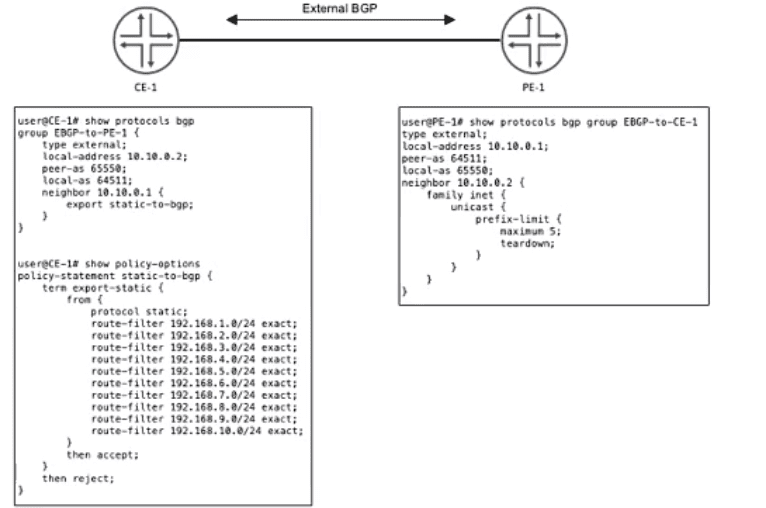
CE-1 must advertise ten subnets to PE-1 using BGP Once CE-1 starts advertising the subnets to PE-1, the BGP peering state changes to Active.
Referring to the CLI output shown in the exhibit, which statement is correct?
A. CE-1 is advertising its entire routing table.
B. CE-1 is configured with an incorrect peer AS
C. The prefix limit has been reached on PE-1
D. CE-1 is unreachable
Explanation:
The exhibit shows CE-1 attempting to advertise ten subnets (192.168.1.0/24 through 192.168.10.0/24) to PE-1 using an export policy static-to-bgp.
Why other options are incorrect
A. CE-1 is advertising its entire routing table
Incorrect. CE-1 is advertising exactly ten static routes via the export policy, not its entire routing table.
B. CE-1 is configured with an incorrect peer AS
Incorrect. CE-1 uses peer-as 65550 and local-as 64511; PE-1 uses peer-as 64511 and local-as 65550. The AS numbers match correctly.
D. CE-1 is unreachable
Incorrect. The BGP session initially establishes (pre‑limit) and only fails after prefix limit is exceeded. Reachability is not the issue.
References:
Junos BGP Configuration Guide: prefix-limit — maximum prefixes allowed from a neighbor. teardown terminates BGP session when limit exceeded. JNCIP‑SP Study Guide: BGP — Prefix limiting and session behavior.
| Page 3 out of 12 Pages |