- 4.9/5.0
- 113 Questions
- Updated on: 12-Oct-2026
- Security, Professional (JNCIP-SEC)
- 1113+ Prepared
- Valid Worldwide
Free JN0-637 Practice Test Questions | Know You're Ready for Security, Professional (JNCIP-SEC)
You Implement persistent NAT to allow any device on the external side of the firewall to
initiate traffic.
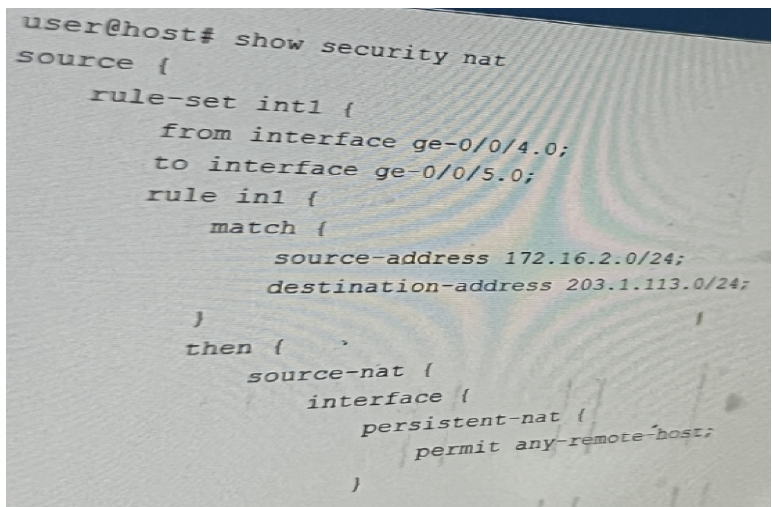
Referring to the exhibit, which statement is correct?
A. The target-host parameter should be used instead of the any-remote-host parameter.
B. The port-overloading parameter needs to be turned off in the NAT source interface configuration
C. The target-host-port parameter should be used instead of the any-remote-host parameter
D. The any-remote-host parameter does not support interface-based NAT and needs an IP pod to work.
Explanation:
B is the Correct Statement: In the exhibit, the source NAT is using the interface parameter, which defaults to port overloading. Port overloading allows multiple internal hosts to share the same public IP by multiplexing their connections onto different source ports.
Why Other Options are Incorrect
A is Incorrect: The target-host parameter restricts return connections to only the specific external host that the internal device originally contacted. The requirement explicitly states that any device on the external side must be able to initiate traffic, which is exactly what the current any-remote-host parameter is designed to do.
C is Incorrect: target-host-port (or target-host) is more restrictive than any-remote-host. Using it would prevent "any" device from initiating traffic, as it would limit access to a single host/port combination.
D is Incorrect: While persistent NAT is often used with NAT pools, the any-remote-host parameter does indeed support interface-based NAT. The primary issue in the exhibit is the port allocation method (overloading), not the use of the interface IP itself.
References:
Juniper Networks TechLibrary: Persistent NAT Overview – explaining that target-host limits return traffic to the original destination.
Junos OS Security Configuration Guide: Configuring Persistent NAT – detailing that any-remote-host allows any external IP to hit the translated port.
Click the Exhibit button.

Referring to the exhibit, which two statements are true? (Choose two.)
A. The traffic is permitted.
B. The traffic was initiated by the 10.10.102.10 address.
C. The destination device is not responding.
D. The traffic is denied.
C. The destination device is not responding.
Explanation:
Why A is correct (Traffic is permitted): The output shows Policy name: L1-to-L9/11 and Session State: Valid. A valid session with a named policy explicitly indicates the traffic matched a security policy and was permitted. Denied traffic does not create a session entry.
Why C is correct (Destination not responding): Packet counts show 1 inbound packet (request from 10.10.101.10 to 10.10.102.10) and 0 outbound packets (no reply). For a successful ICMP ping, the SRX expects equal packets in both directions. Zero return packets means the destination device is not responding (offline, ICMP blocked, or unreachable).
Why B is incorrect (10.10.102.10 initiated): The In: field shows 10.10.101.10 → 10.10.102.10. The first IP address listed is always the session initiator. Therefore, 10.10.101.10 started the traffic.
Why D is incorrect (Traffic denied):If traffic were denied, no session would appear in show security flow session output, or the state would show Rejected—never Valid with a policy name.
References
Juniper show security flow session CLI reference Policy name and Session State: Valid indicate a permitted session
ExamTopics JN0-637 discussionCommunity verifies A and C; packet asymmetry (1 in / 0 out) confirms no reply from destination
Exhibit:
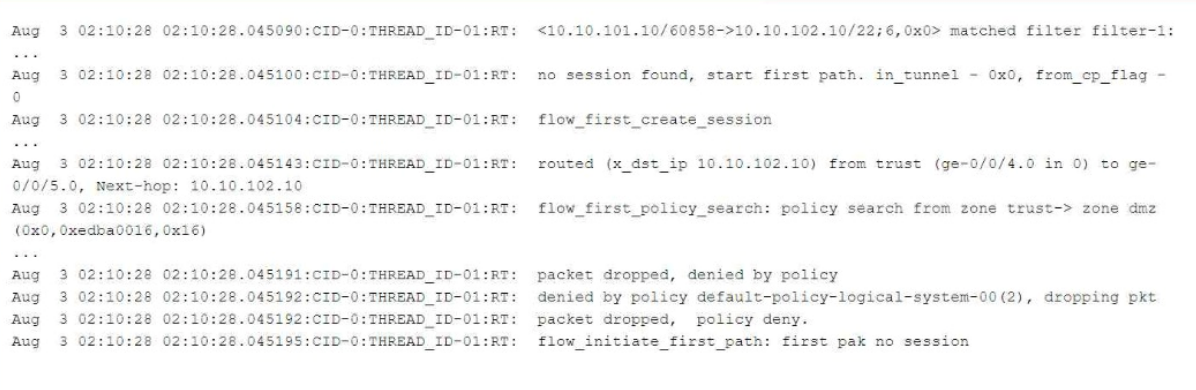
Referring to the flow logs exhibit, which two statements are correct? (Choose two.)
A. The packet is dropped by the default security policy.
B. The packet is dropped by a configured security policy.
C. The data shown requires a traceoptions flag of host-traffic.
D. The data shown requires a traceoptions flag of basic-datapath.
D. The data shown requires a traceoptions flag of basic-datapath.
Explanation:
A is Correct: The log explicitly states: denied by policy default-policy-logical-system-00(2), dropping pkt. This indicates that after the flow_first_policy_search from the trust zone to the dmz zone, the SRX could not find a matching user-defined policy. Consequently, it fell back to the system's default-policy, which is set to deny traffic by default.
D is Correct: The output shown is the result of flow traceoptions. To see the specific "first path" packet processing steps—including session creation attempts, route lookups, and policy evaluations—the flag basic-datapath must be enabled under [edit security flow traceoptions]. This flag provides the standard level of detail for debugging transit traffic issues.
Why the Other Options are Incorrect
B is Incorrect: If a user-configured policy had dropped the packet, the log would typically reference the specific name of that policy (e.g., denied by policy 'Block-SSH'). Instead, it explicitly names the default-policy.
C is Incorrect: The host-traffic flag is used specifically for debugging traffic destined for or originating from the SRX itself (control plane traffic). The exhibit shows transit traffic (a packet from 10.10.101.10 to 10.10.102.10 being routed), which is handled by the basic-datapath flag.
References
Juniper Networks TechLibrary: Tracing Packets That Traverse the Flow Module (Command Line) – explaining the use of basic-datapath for transit packet debugging.
Junos OS Security Configuration Guide: Security Policies Overview – detailing how traffic is dropped by the default-deny policy when no match is found.
An ADVPN configuration has been verified on both the hub and spoke devices and it
seems fine. However, OSPF is not functioning as expected.
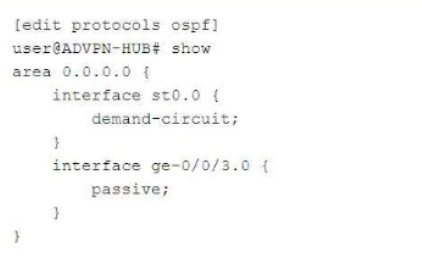
Referring to the exhibit, which two statements under interface st0.0 on both the hub and
spoke devices would solve this problem? (Choose two.)
A. interface-type p2mp
B. dynamic-neighbors
C. passive
D. interface-type p2p
B. dynamic-neighbors
Explanation:
A is Correct: By default, OSPF treats tunnel interfaces as point-to-point (P2P). In an ADVPN or Hub-and-Spoke topology, a single st0.0 interface on the hub must communicate with multiple spokes. Configuring the interface type as point-to-multipoint (p2mp) allows OSPF to establish multiple adjacencies over a single logical interface. This also eliminates the need for a Designated Router (DR) or Backup Designated Router (BDR) election, which is unsuitable for this type of environment.
B is Correct: Because the spokes in an ADVPN deployment often have dynamic public IP addresses, the hub cannot explicitly define every neighbor's IP address in the OSPF configuration. The dynamic-neighbors statement allows the OSPF process to automatically form adjacencies with any neighbor that sends a valid Hello packet over the st0.0 interface, provided they are within the same subnet.
Why the Other Options are Incorrect
C is Incorrect: Setting an interface to passive prevents OSPF from sending or receiving Hello packets on that interface. This would completely disable the formation of OSPF adjacencies over the tunnel, which is the opposite of the desired goal.
D is Incorrect: As mentioned, the default type is often p2p. In a hub-and-spoke environment, P2P is generally inappropriate for the hub's interface because it only expects a single neighbor. Using P2P would prevent the hub from forming adjacencies with all spokes simultaneously.
References
Juniper Networks TechLibrary: ADVPN Overview – explaining the requirement for P2MP OSPF to support multiple spokes on a single st0 interface.
Junos OS Routing Protocols Configuration Guide: OSPF Point-to-Multipoint Networks – detailing the use of dynamic-neighbors for environments where neighbor IPs are not static.
Click the Exhibit button.
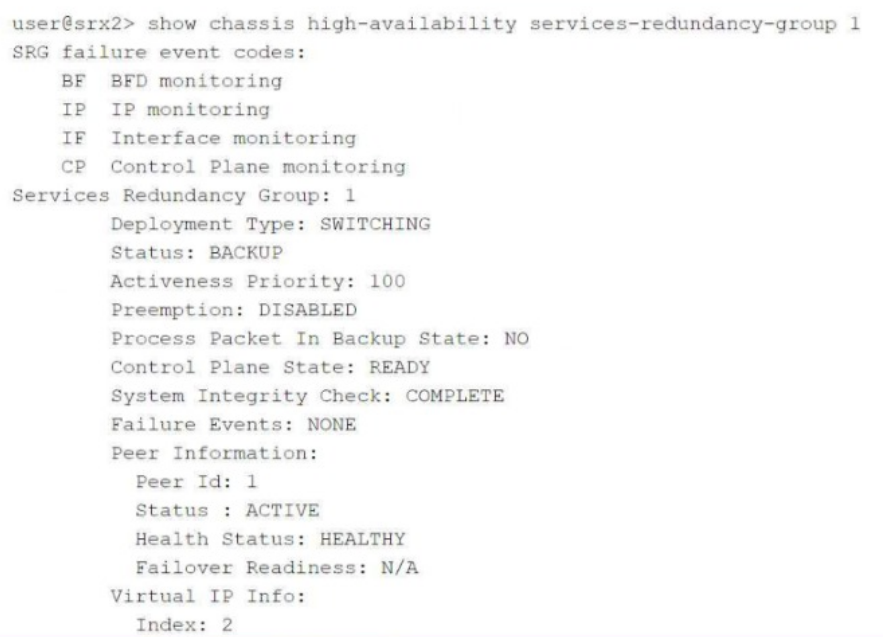
Referring to the exhibit, which two statements are correct? (Choose two.)
A. This device is the backup node for SRG1.
B. The ge-0/0/3.0 and ge-0/0/4.0 interfaces are not active and will not respond to ARP requests to the virtual IP MAC address.
C. This device is the active node for SRG1.
D. The ge-0/0/3.0 and ge-0/0/4.0 interfaces are active and will respond to ARP requests to the virtual IP MAC address.
B. The ge-0/0/3.0 and ge-0/0/4.0 interfaces are not active and will not respond to ARP requests to the virtual IP MAC address.
Explanation:
A is Correct: The Status field under Services Redundancy Group: 1 explicitly shows the state as BACKUP. Furthermore, the Peer Information section shows that the remote peer (Peer Id: 1) is currently the ACTIVE node.
B is Correct: In a Juniper Multinode High Availability (HA) scenario, when a node is in the BACKUP state for a specific Services Redundancy Group (SRG), its associated data interfaces do not process transit traffic. The exhibit confirms this by showing Process Packet In Backup State: NO. Consequently, the interfaces assigned to this SRG (such as the ge-0/0/3.0 and ge-0/0/4.0 interfaces mentioned in the scenario) will not respond to ARP requests for the Virtual IP (VIP) because that responsibility lies solely with the currently active node.
Why the Other Options are Incorrect
C is Incorrect: The output explicitly identifies the local node's status for SRG1 as BACKUP, not active.
D is Incorrect: Because the node is in the backup state and Process Packet In Backup State is disabled, the interfaces will remain inactive for transit traffic and will not respond to ARP requests for the virtual MAC address.
References
Juniper Networks TechLibrary: Multinode High Availability Services Redundancy Group Status – explaining the behavior of backup nodes in an HA cluster.
JNCIP-SEC (JN0-637) Exam Objectives: Section 1.3 – Describe the concepts, operation, and configuration of High Availability (Multinode HA).
Exhibit:
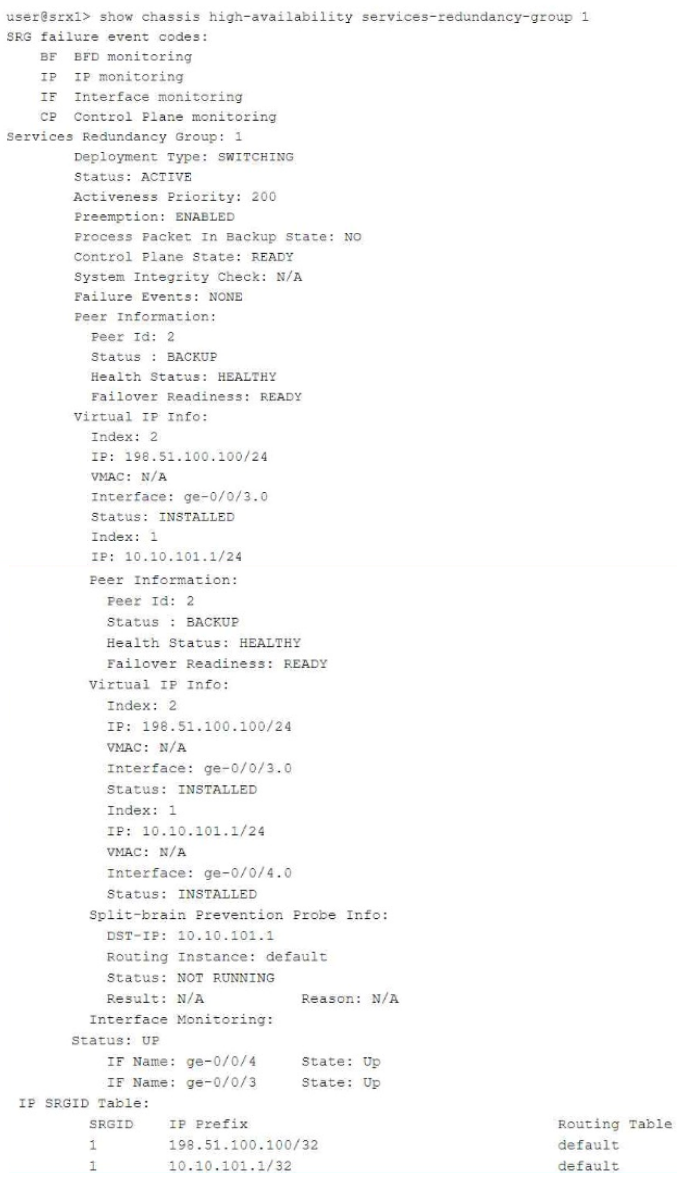
Referring to the exhibit, which two statements are correct? (Choose two.)
A. The ge-0/0/3.0 and ge-0/0/4.0 interfaces are not active and will not respond to ARP requests to the virtual IP MAC address.
B. This device is the backup node for SRG1.
C. The ge-0/0/3.0 and ge-0/0/4.0 interfaces are active and will respond to ARP requests to the virtual IP MAC address.
D. This device is the active node for SRG1.
D. This device is the active node for SRG1.
Explanation:
D is Correct: In the exhibit, the Status field under Services Redundancy Group: 1 explicitly shows ACTIVE. Additionally, the Peer Information section confirms that the remote device (Peer Id: 2) is currently in the BACKUP state.
C is Correct: Because this node is in the ACTIVE state for SRG1, it is responsible for all traffic processing and control plane tasks for that group. The Virtual IP Info section shows that the Virtual IPs (198.51.100.100 and 10.10.101.1) are associated with interfaces ge-0/0/3.0 and ge-0/0/4.0, and their status is INSTALLED. As the active node, these interfaces will actively respond to ARP requests for the virtual IP addresses.
Why the Other Options are Incorrect
A is Incorrect: This statement describes the behavior of a backup node. Since the exhibit shows the local node is active, these interfaces are fully operational for transit traffic.
B is Incorrect: The output clearly identifies the local node (srx1) as the active node for SRG1, while the peer is the backup.
References
Juniper Networks TechLibrary: Multinode High Availability Services Redundancy Group Status – detailing the operational differences between active and backup nodes.
JNCIP-SEC (JN0-637) Exam Objectives:Section 1.3 – Describe the concepts, operation, and configuration of High Availability (Multinode HA).
| Page 6 out of 15 Pages |