- 4.9/5.0
- 113 Questions
- Updated on: 25-May-2026
- Security, Professional (JNCIP-SEC)
- 1113+ Prepared
- Valid Worldwide
Free JN0-637 Practice Test Questions | Know You're Ready for Security, Professional (JNCIP-SEC)
Your customer needs embedded security in an EVPN-VXLAN solution.
What are two benefits of adding an SRX Series device in this scenario? (Choose two.)
A. It enhances tunnel inspection for VXLAN encapsulated traffic with Layer 4-7 security services.
B. It adds extra security with the capabilities of an enterprise-grade firewall in the EVPNVXLAN underlay.
C. It adds extra security with the capabilities of an enterprise-grade firewall in the EVPNVXLAN overlay.
D. It enhances tunnel inspection for VXLAN encapsulated traffic with only Layer 4 security services.
C. It adds extra security with the capabilities of an enterprise-grade firewall in the EVPNVXLAN overlay.
Explanation:
A is Correct: Modern SRX Series devices (with recent Junos versions) support VXLAN GPE (Generic Protocol Extension) and deep inspection. This allows the SRX to act as a hardware-based or virtualized VTEP (VXLAN Tunnel Endpoint) that can decapsulate VXLAN traffic, apply advanced security services—such as IPS, AppSecure, and Content Security (Layer 4-7)—and then re-encapsulate the traffic to its destination. This is critical for inspecting "East-West" traffic between virtualized workloads.
C is Correct: In an EVPN-VXLAN architecture, the Overlay is the virtualized network where the actual tenant traffic and segments (VNIs) reside. By placing an SRX in the overlay (often as a "Service Leaf" or a centralized gateway), you provide enterprise-grade firewalling (Stateful inspection, UserFW, etc.) to the virtual networks. It ensures that even though the physical infrastructure is shared, the logical overlay remains secure.
Why the Other Options are Incorrect
B is Incorrect: The Underlay is the physical IP network (the spines and leaves) responsible only for transporting encapsulated packets from one VTEP to another. While you need basic connectivity in the underlay, you do not typically place an enterprise-grade firewall there for security services, as the traffic in the underlay is already encapsulated and "blind" to the firewall unless decapsulated.
D is Incorrect: Limiting the SRX to "only Layer 4" security services would ignore its primary value proposition. The SRX is chosen in these high-end deployments specifically because it can perform Layer 7 application identification and deep packet inspection (DPI) on the traffic emerging from the VXLAN tunnels.
References
Juniper Networks TechLibrary: VXLAN Security Overview – detailing how SRX devices provide Layer 4-7 services for VXLAN-based data center fabrics.
Junos OS Data Center Architecture Guide: EVPN-VXLAN with SRX Series – explaining the role of the SRX as a security gateway in the overlay.
You have deployed two SRX Series devices in an active/passive multimode HA scenario.
In this scenario, which two statements are correct? (Choose two.)
A. Services redundancy group 1 (SRG1) is used for services that do not have a control plane state.
B. Services redundancy group 0 (SRG0) is used for services that have a control plane state.
C. Services redundancy group 0 (SRG0) is used for services that do not have a control plane state.
D. Services redundancy group 1 (SRG1) is used for services that have a control plane state.
Explanation:
C is Correct: SRG0 is a special system-defined group. It is designed for services that are "stateless" or do not require a unified control plane state to be synchronized between the nodes. This typically includes management traffic and specific system-level processes that stay local to each node. In an active/passive setup, SRG0 allows each node to maintain its own basic operational readiness without needing constant state updates for these specific background tasks.
D is Correct: SRG1 (and higher numbered groups) are used for the actual traffic processing services. These are services that do have a control plane state, such as stateful firewall sessions, NAT mappings, and IPsec VPNs. In an active/passive scenario, SRG1 is active on the primary node and passive on the secondary node. The control plane state for these services is synchronized from the primary node to the secondary node so that if a failover occurs, the secondary node can take over existing sessions without interruption.
Why the Other Options are Incorrect
A and B are Incorrect: These options swap the definitions of SRG0 and SRG1. Remember that in the Junos HA architecture (both traditional chassis clusters and Multinode HA), the lower-numbered group (SRG0) is always reserved for the local node's system/control-link tasks, while higher-numbered groups (SRG1+) handle the synchronized data plane services.
References
Juniper Networks TechLibrary: Multinode High Availability Components – explaining the roles of SRG0 and SRG1.
Junos OS Security Configuration Guide: Configuring Services Redundancy Groups – detailing how stateful vs. stateless services are allocated.
You are configuring an interconnect logical system that is configured as a VPLS switch to
allow two logical systems to communicate.
Which two parameters are required when configuring the logical tunnel interfaces?
(Choose two.)
A. Encapsulation ethernet must be used.
B. The virtual tunnel interfaces should only be configured with two logical unit pairs per logical system interconnect.
C. The logical tunnel interfaces should be configured with two logical unit pairs per logical system interconnect.
D. Encapsulation ethernet-vpls must be used.
Explanation:
C is Correct: A logical tunnel always operates as a paired connection. To connect a Logical System (LS-A) to the Interconnect VPLS switch (LS-Switch), you must create a pair of units on the lt- interface (e.g., unit 1 and unit 2). One unit is placed inside the tenant Logical System, and its "peer-unit" is placed inside the VPLS Logical System. If you are connecting two different tenant systems to the same VPLS switch, you would need two distinct pairs (four units total).
D is Correct: Because the interconnect logical system is acting as a VPLS switch, the logical tunnel unit that resides within that VPLS logical system must be configured with encapsulation ethernet-vpls. This tells the SRX to treat that logical interface as a bridge port capable of handling VPLS-specific encapsulation and learning MAC addresses within the VPLS instance.
Why the Other Options are Incorrect
A is Incorrect: While encapsulation ethernet is a valid logical tunnel encapsulation, it is typically used for standard Layer 2 transparent bridging or simple ISO cross-connects. For a VPLS-based interconnect, the specific ethernet-vpls encapsulation is required for the interface to be accepted as a member of a VPLS routing instance.
B is Incorrect: This is a distractor. The number of units is not strictly limited to "only two" in a global sense; rather, the fundamental requirement is that they must be configured in pairs to establish the internal link.
References
Juniper Networks TechLibrary: Configuring Logical Tunnel Interfaces for VPLS – explaining the mandatory use of ethernet-vpls encapsulation.
Junos OS Routing Protocols Configuration Guide: VPLS and Logical Systems – detailing the peer-unit pairing mechanism.
You have deployed a new site as shown in the exhibit. Hosts in the 10.10.10.0/24 network
must access the DB1 server. The DB1 server must also have internet access the DB1
server encrypted.
Which two configuration statements will be required as part of the configuration on SRX1 to
satisfy this requirement? (Choose two)
A. set security macsec interfaces ge-0/0/1 connectivity association access-sw
B. set protocols 12-learning global mode transpårent-bridge
C. set security forwarding-options secure-wire access-sw interface ge-0/0/1.0
D. set security macsec connectivity-association access-sw security-mode static-cak
Explanation:
D is Correct: To enable MACsec, you must first define a Connectivity Association (CA). This acts as the container for your security settings. Using security-mode static-cak (Static Connectivity Association Key) is the standard method for establishing a pre-shared key between the SRX and the switch to generate the necessary encryption keys (SAKs).
A is Correct: Defining the CA is not enough; you must apply it to the specific physical interface connected to the neighbor (in this case, ge-0/0/1 connecting to the access switch). This statement binds the security profile to the port, triggering the MACsec Key Agreement (MKA) protocol over that link.
Why the Other Options are Incorrect
B is Incorrect: Switching the device to transparent-bridge mode affects how the SRX handles Layer 2 frames globally, but it is not a requirement for MACsec. MACsec can operate on routed interfaces or within a transparent bridge, but the prompt asks for what is required for encryption, not general forwarding behavior.
C is Incorrect: Secure-wire (also known as a virtual wire) is a method to pass traffic transparently through the SRX without MAC learning or IP processing. While useful for some deployments, it is distinct from MACsec encryption. You do not need to configure a secure-wire to enable Layer 2 encryption on an interface.
References
Juniper Networks TechLibrary: MACsec Overview for SRX Series – outlining the configuration hierarchy using security macsec.
Junos OS Security Configuration Guide: Configuring MACsec with Static CAK – detailing the mandatory steps of defining a CA and binding it to an interface.
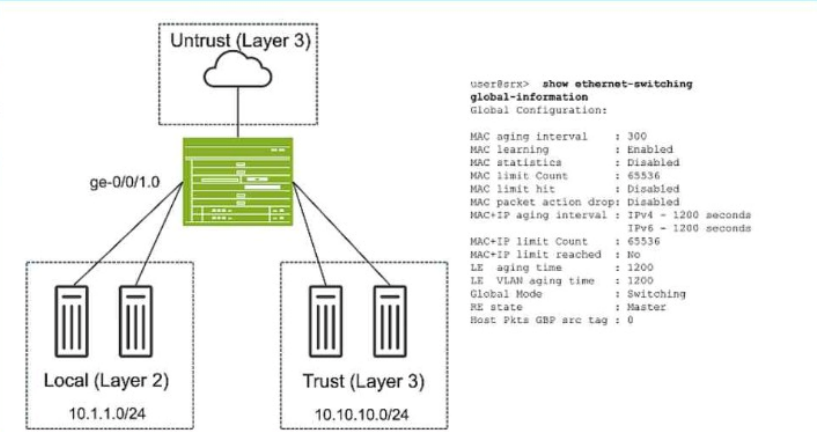
Exhibit:

Referring to the exhibit, which two statements are true? (Choose two.)
A. Hosts in the Local zone can be enabled for control plane access to the SRX.
B. An IRB interface is required to enable communication between the Trust and the Untrust zones.
C. You can configure security policies for traffic flows between hosts in the Local zone.
D. Hosts in the Local zone can communicate with hosts in the Trust zone with a security policy.
C. You can configure security policies for traffic flows between hosts in the Local zone.
Explanation:
A is Correct: Even though the Local zone is a Layer 2 zone, you can still allow management or control plane access (such as SSH, HTTPS, or Ping) from hosts within that zone to the SRX. This is done by configuring host-inbound-traffic under the security zone or the specific logical interface (e.g., ge-0/0/1.0).
C is Correct: On SRX devices in switching mode, you can implement Intra-zone security policies. This allows you to inspect and control Layer 2 traffic between hosts that reside within the same VLAN and the same security zone. This is a key feature for implementing micro-segmentation at the access layer.
Why the Other Options are Incorrect
B is Incorrect: An IRB (Integrated Routing and Bridging) interface is used to connect a Layer 2 domain to a Layer 3 domain. While it allows the Local zone (L2) to reach the Trust zone (L3), it is not required for communication between two Layer 3 zones like Trust and Untrust. Communication between Trust and Untrust is handled via standard Layer 3 routing and security policies.
D is Incorrect: Because the Local zone is strictly Layer 2 and the Trust zone is Layer 3, they are in different broadcast domains and different subnets. While a security policy is necessary to allow the traffic, a policy alone is insufficient; you would also need a Layer 3 gateway (like an IRB interface) to route the traffic between the 10.1.1.0/24 and 10.10.10.0/24 networks.
Referring to the exhibit, you are attempting to set up a remote access VPN on your SRX
series devices.
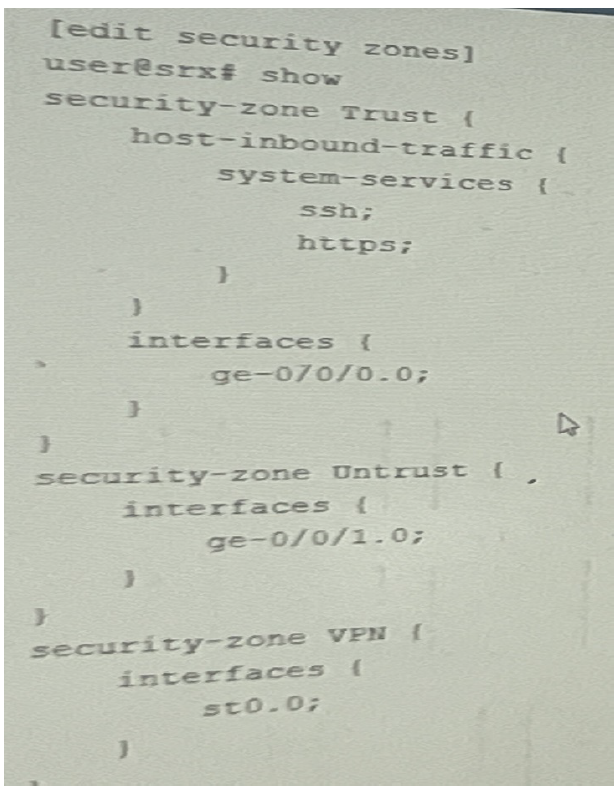
However you are unsure of which system services you should allow and in which zones
they should be allowed to correctly finish the remote access VPN configuration
Which two statements are correct? (Choose two.)
A. You should add the host-inbound-traffic system-service ike statement to the Untrust zone.
B. You should add the host-inbound-traffic system-service ike statement to the VPN zone.
C. You should add the host-inbound-traffic system-service tcp-encap statement to the Untrust zone
D. You should add the host-inbound-traffic system-service tcp-encap statement to the VPN zone
C. You should add the host-inbound-traffic system-service tcp-encap statement to the Untrust zone
Explanation:
A is Correct: To establish a VPN tunnel, the SRX must be able to negotiate the Internet Key Exchange (IKE) protocol. For a remote access VPN, the external clients connect to the gateway via the internet-facing interface. Therefore, you must allow the ike system service under host-inbound-traffic in the Untrust zone (where the physical WAN interface ge-0/0/1.0 resides).
C is Correct: Juniper remote access solutions (like Juniper Secure Connect) often utilize TCP encapsulation to allow VPN traffic to pass through environments where UDP (standard for IKE/ESP) might be blocked. Enabling tcp-encap in the Untrust zone allows the SRX to terminate these encapsulated SSL/TCP connections from remote clients.
Why the Other Options are Incorrect
B and D are Incorrect: The VPN zone typically contains the logical st0.0 (secure tunnel) interface. This zone represents the traffic inside the tunnel once it has already been decrypted. You do not negotiate the tunnel parameters (like IKE or TCP-Encap) on the tunnel interface itself; those negotiations must happen on the physical "underlay" interface in the Untrust zone before the tunnel can even be established.
Exhibit:
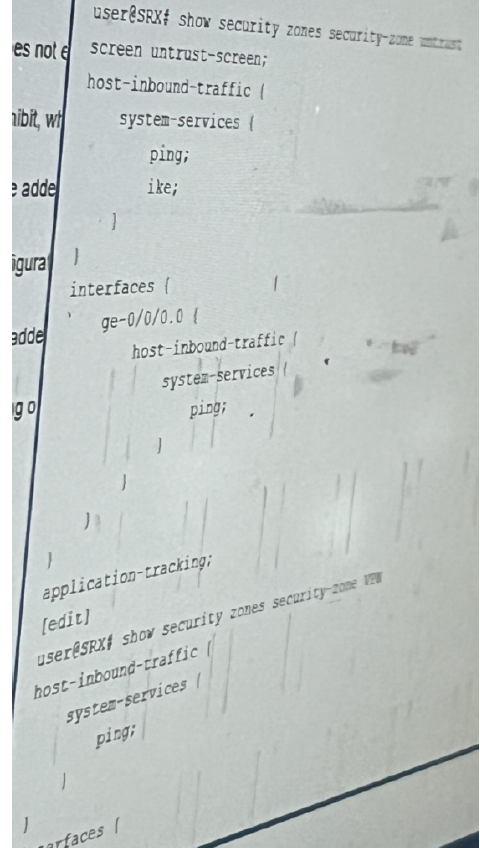
The Ipsec VPN does not establish when the peer initiates, but it does establish when the
SRX
series device initiates. Referring to the exhibit, what will solve this problem?
A. IKE needs to be added for the host-inbound traffic on the VPN zone.
B. The screen configuration on the untrust zone needs to be modified.
C. IKE needs to be added to the host-inbound traffic directly on the ge-0/0/0 interface.
D. Application tracking on the untrust zone needs to be removed.
Explanation:
C is the Correct Statement: In Junos OS, when host-inbound-traffic is configured at both the zone level and the interface level, the settings applied directly to the logical interface take absolute precedence.
Why Other Options are Incorrect
A is Incorrect: IKE negotiation for the tunnel underlay must occur on the physical WAN interface (Untrust zone) rather than the logical tunnel interface (VPN zone).
B is Incorrect: While a Screen could potentially drop packets, the hierarchical override on the interface configuration is the direct cause of this specific failure.
D is Incorrect: application-tracking is a tool for traffic visibility and logging; it does not possess the authority to block the establishment of the IKE control plane.
References
Juniper Networks TechLibrary: Understanding Host-Inbound Traffic – explaining the precedence of interface-level settings over zone-level settings.
Junos OS Security Configuration Guide: Security Zones – detailing how to configure and troubleshoot allowed system services.
You are deploying IPsec VPNs to securely connect several enterprise sites with ospf for dynamic routing. Some of these sites are secured by third-party devices not running Junos. Which two statements are true for this deployment? (Choose two.)
A. OSPF over IPsec can be used for intersite dynamic routing.
B. Sites with overlapping address spaces can be supported.
C. OSPF over GRE over IPsec is required to enable intersite dynamic routing
D. Sites with overlapping address spaces cannot be supported.
Explanation:
C is Correct: Standard IPsec tunnels (Route-Based or Policy-Based) natively support only unicast traffic. Since OSPF relies on multicast (224.0.0.5 and 224.0.0.6) for neighbor discovery and link-state updates, it cannot run directly inside a standard IPsec tunnel. To bridge this gap, especially with third-party devices, a GRE (Generic Routing Encapsulation) tunnel is used to encapsulate the OSPF multicast packets into unicast packets. These GRE packets are then encrypted by IPsec. This "OSPF over GRE over IPsec" stack is the industry-standard method for ensuring interoperability between different vendors.
D is Correct: OSPF is a link-state routing protocol that requires a consistent and unique map of the network across all participating routers. If two sites have overlapping address spaces (e.g., both sites using 192.168.1.0/24), OSPF will encounter a conflict in the link-state database (LSDB). The routers will see two different paths to the same destination, leading to routing instability, packet loss, or sub-optimal routing. OSPF does not have an inherent mechanism to resolve these overlaps.
Why the Other Options are Incorrect
A is Incorrect: This statement is too broad. While OSPF is used for routing, it cannot be used directly over a standard IPsec tunnel without a transition mechanism like GRE or specialized Juniper-proprietary features that might not be compatible with third-party devices.
B is Incorrect: As noted in option D, overlapping address spaces are a fundamental violation of standard OSPF routing logic and are not supported in a standard dynamic routing deployment.
References
Juniper Networks TechLibrary: Configuring OSPF Over a GRE Tunnel Protected by IPsec – detailing the requirement for GRE to handle multicast traffic between diverse vendors.
Junos OS Routing Protocols Configuration Guide: OSPF Overview – explaining the necessity for unique addressing within an OSPF area.
| Page 5 out of 15 Pages |