- 4.9/5.0
- 106 Questions
- Updated on: 7-Sep-2026
- Enterprise Routing and Switching Specialist (JNCIS-ENT)
- 1106+ Prepared
- Valid Worldwide
Free JN0-351 Practice Test Questions | Know You're Ready for Enterprise Routing and Switching Specialist (JNCIS-ENT)
Exhibit
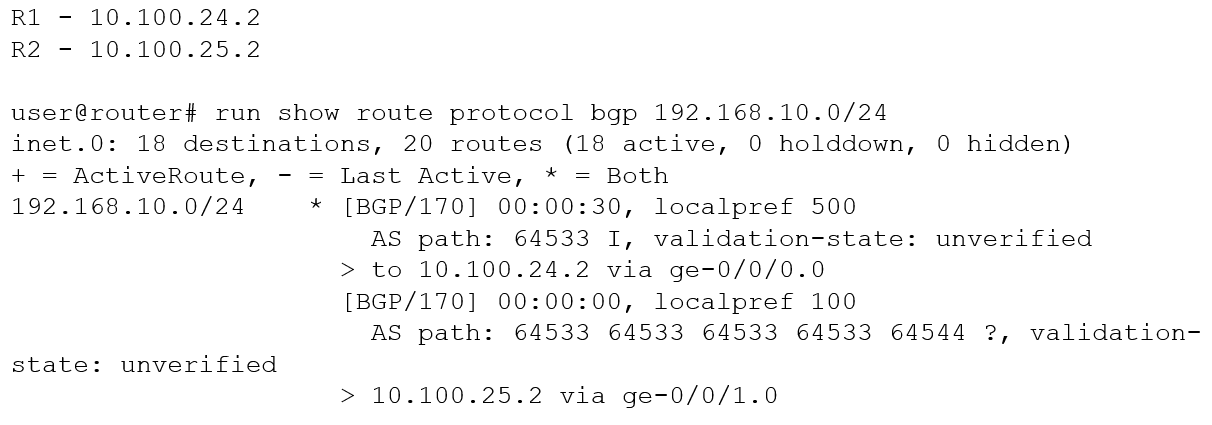
You are troubleshooting an issue where traffic to 192.168.10.0/24 is being sent to R1
instead of your desired path through R2.
Referring to the exhibit, what is the reason for the problem?
A. R2's route is not the best path due to loop prevention.
B. R2's route is not the best path due to a lower origin code.
C. R1's route is the best path due to a higher local preference
D. R1's route is the best path due to the shorter AS path.
Explanatio:
The show route protocol bgp 192.168.10.0/24 output displays two BGP routes for the same prefix. The active (best) route is marked with * and > and is via R1 (10.100.24.2). The second route via R2 (10.100.25.2) is shown but is not the active route. BGP path selection is deterministic, following a series of attributes in a specific order.
Why other options are wrong:
A. R2's route is not the best path due to loop prevention.
Incorrect. Loop prevention in BGP typically involves AS path loops (detecting own AS number in the path). The exhibit shows R2's route having multiple repetitions of AS 64533, but that alone does not indicate a loop — and even if it were a loop, the route would be hidden, not presented as an alternate. Loop prevention is not the primary reason here; local preference overrides.
B. R2's route is not the best path due to a lower origin code. Incorrect. Origin code (I vs ?) is compared after local preference, AS path length, and origin type. Even if R2 had a better origin (which it does not — ? is considered less preferred than I), local preference has already decided the winner. The statement implies origin is the reason, but it is not.
D. R1's route is the best path due to the shorter AS path.
Incorrect. R1's AS path length is 1 (just 64533). R2's AS path length is 4 (64533 64533 64533 64534). Shorter AS path is generally better, but BGP compares local preference before AS path length. Here, local preference already selects R1; the shorter AS path is consistent but not the deciding factor. The question asks for the reason given the exhibited data — localpref is the clear, highest-priority differentiator.
Reference:
Juniper TechLibrary: “BGP Path Selection Algorithm”
– “BGP selects the best route based on the following order: highest local preference, shortest AS path, lowest origin type, lowest MED, eBGP over iBGP, lowest IGP metric to next hop, lowest router ID.”
JNCIS‑ENT Study Guide (BGP chapter)
– “Local preference is the most influential attribute for outbound route selection within an AS; higher value wins.”
Click the Exhibit button.
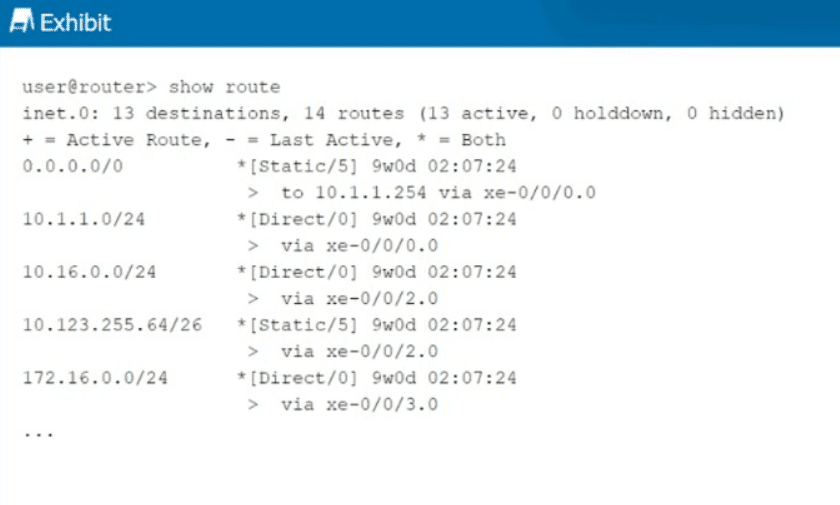
You want to redistribute the static routes into BGP, but they do not show as BGP routes.
What causes this result to occur?
A. The static routes do not have a valid next hop.
B. The as-path parameter must be specified.
C. A community string must be configured.
D. The no-readvertise feature is specified.
Explanation:
For a static route to be successfully redistributed into BGP (or any dynamic routing protocol), the route must first be active in the routing table. A route is marked as active only if its next hop is valid and recursively resolvable through other active routes in the table.
Why Other Options Are Incorrect
B. The as-path parameter must be specified.
— Incorrect. The AS path attribute is automatically added by BGP when a route is advertised. You do not need to manually specify an AS path for static routes to be redistributed into BGP.
C. A community string must be configured.
— Incorrect. BGP communities are optional transitive attributes used for tagging and policy application. They are never a requirement for redistributing static routes into BGP.
D. The no-readvertise feature is specified.
— Incorrect. The no-readvertise parameter is a specific static route option that prevents a route from being exported from the routing table into any dynamic routing protocol. If no-readvertise were configured, the static routes would still appear in show route (as they do in the exhibit), but the export policy would not be able to readvertise them. However, the question asks what causes the static routes to not show as BGP routes after attempting redistribution. While no-readvertise is a valid reason, it is not the most correct answer here because:
The question implies a general troubleshooting scenario rather than a specific misconfiguration
The exhibit shows a routing table without indicating no-readvertise is configured
With static route redistribution, the first and most common issue to verify is next-hop validity
References
Juniper TechLibrary: "Static routes are eligible to be readvertised... To mark an IPv4 static route as being ineligible for readvertisement, include the no-readvertise statement"
Pupuweb (JN0-351 exam discussion): "For successful redistribution of static routes into BGP, the static routes must have a valid next hop"
| Page 3 out of 14 Pages |