- 4.9/5.0
- 66 Questions
- Updated on: 12-Oct-2026
- Security, Specialist (JNCIS-SEC)
- 166+ Prepared
- Valid Worldwide
Free JN0-336 Practice Test Questions | Know You're Ready for Security, Specialist (JNCIS-SEC)
You are asked to configure your company SRX Series device to use identity-aware security
policies. Information about your Active Directory network is shown in the exhibit.
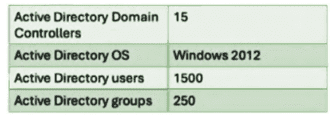
In this scenario, why must you configure JIMS instead of Active Directory as an identity source?
A. JIMS is the only way to get data from Active Directory.
B. You have too many Active Directory users.
C. The version of Windows OS is too old.
D. You have too many domain controllers.
Explanation:
The SRX Series firewall has a scalability limit when using Active Directory directly as an identity source. Specifically, with the local Active Directory authentication table method, the device supports a maximum of 5 domain controllers . Since the exhibit shows the network has 15 domain controllers, this deployment clearly exceeds the firewall's native limit, making the use of the more scalable Juniper Identity Management Service (JIMS) necessary.
Correct Option:
D. You have too many domain controllers.
The local Active Directory identity source option on SRX firewalls supports a maximum of 5 domain controllers. The exhibit clearly shows 15 domain controllers in your Active Directory network, exceeding this limit and requiring JIMS for proper functionality . JIMS supports up to 20 domain controllers, which can scale to 150 .
Incorrect Option:
A. JIMS is the only way to get data from Active Directory.
This is incorrect. The SRX Series device can be configured to use Active Directory directly as an identity source without JIMS, provided the number of domain controllers is within the supported limit . JIMS is an alternative, more scalable solution.
B. You have too many Active Directory users.
This is incorrect. The local Active Directory authentication table supports a substantial number of users—up to 256,000 active entries. With only 250 users, this does not present a scaling issue and would not be a reason to deploy JIMS .
C. The version of Windows OS is too old.
This is incorrect. The Windows 2012 operating system specified in the exhibit is fully supported by both the direct Active Directory method and JIMS . The SRX can integrate with Active Directory versions as early as 2008 R2 .
Reference:
Juniper Networks Documentation: "SRX Series Firewall supports a maximum of 5 domain controllers and 256,000 entries in the authentication table" .
Juniper Networks Documentation: JIMS supports up to 20 domain controllers, scalable to 150 .
Regarding static attack object groups, which two statements are true? (Choose two.)
A. Matching attack objects are automatically added to a custom group.
B. Group membership automatically changes when Juniper updates the IPS signature database.
C. Group membership does not automatically change when Juniper updates the IPS signature database.
D. You must manually add matching attack objects to a custom group.
Explanation:
A static attack object group is a custom, user-defined set of attack objects.
Its membership is explicitly defined by the administrator and does not change automatically . Consequently, you must manually add or remove attack objects to update the group's membership, and Juniper's signature database updates will not automatically modify it .
Correct Option:
C. Group membership does not automatically change when Juniper updates the IPS signature database.
Static groups are defined by a fixed list of attack objects specified by the user . Therefore, signature database updates do not alter the group's content; they only affect the predefined attack objects within the database itself.
D. You must manually add matching attack objects to a custom group.
To include an attack object in a static group, the administrator must manually select and add it . They are not automatically populated based on criteria.
Incorrect Option:
A. Matching attack objects are automatically added to a custom group.
This describes the behavior of a dynamic group, not a static one. Dynamic groups automatically add or remove attack objects based on filters like severity or product .
B. Group membership automatically changes when Juniper updates the IPS signature database.
This is incorrect for static groups. While dynamic groups can automatically gain new members during an update (if they match the filters) , static groups require manual intervention for any membership change .
Reference:
Juniper Networks Documentation: "Custom attack groups are static because the attacks are specified in the group. Consequently, when the security database is updated, the attack group does not change."
Juniper Networks Documentation: "Static groups require more maintenance than dynamic groups because you must manually add or remove attack objects in a static group to change its members."
Which two functions does Juniper ATP Cloud perform to reduce delays in the inspection of files? (Choose two.)
A. Juniper ATP Cloud allows the creation of allowlists.
B. Juniper ATP Cloud uses a single antivirus software package to analyze files.
C. Juniper ATP Cloud allows end users to bypass the inspection of files.
D. Juniper ATP Cloud performs a cache lookup on files.
Explanation:
Juniper ATP Cloud employs several techniques to minimize latency during file inspection. It uses allowlists to exempt trusted, known-safe files from analysis, bypassing the scanning process entirely. It also uses a cache lookup to check if a file has been analyzed previously; if a cached verdict exists, it is returned immediately without re-scanning. These methods significantly reduce processing time compared to a full analysis.
Correct Option:
A. Juniper ATP Cloud allows the creation of allowlists.
Allowlists let you define files, file hashes, or domains that are considered trusted and should be excluded from malware scanning. When a file matches an allowlist entry, the SRX bypasses sending it to the cloud for analysis, which greatly reduces delay and network bandwidth usage.
D. Juniper ATP Cloud performs a cache lookup on files.
Before analyzing any file, Juniper ATP Cloud checks its local cache to see if a verdict for that specific file hash already exists. If a cache hit occurs, the known threat score is returned immediately, eliminating the need for a full analysis and significantly reducing inspection time.
Incorrect Option:
B. Juniper ATP Cloud uses a single antivirus software package to analyze files.
This statement is incorrect. To improve detection accuracy and reduce false positives, Juniper ATP Cloud uses multiple antivirus software packages, not just one, to analyze files from different perspectives.
C. Juniper ATP Cloud allows end users to bypass the inspection of files.
End users cannot bypass file inspection. This is a critical security function controlled entirely by the administrator through security policies on the SRX Series device. Allowing end-user bypass would create a significant security vulnerability.
Reference:
Juniper Networks Documentation: File Inspection Profiles - "you can create several profiles and each profile can contain different options for how each file type is scanned"
Juniper Networks Documentation: show services security-metadata-streaming command - "Number of cache hits"
Which statement is correct about Active Directory as an identity source for identity-aware security policies?
A. It supports a maximum of two domains.
B. It supports logical systems.
C. It supports 20 Active Directory servers per domain.
D. It tracks non-Windows Active Directory users.
Explanation:
When Active Directory is configured directly as an identity source on an SRX Series device, the integrated user firewall feature has a scalability limit: it supports a maximum of two Windows domains. This is a key architectural constraint of this deployment model, distinguishing it from the more scalable Juniper Identity Management Service (JIMS) solution.
Correct Option:
A. It supports a maximum of two domains.
The Juniper documentation explicitly states that the integrated user firewall feature for Active Directory authentication "supports up to two Windows domains". This is a hard limit and a critical factor to consider when designing identity-aware security policies using Active Directory directly.
Incorrect Option:
B. It supports logical systems.
The documentation for Active Directory as an identity source does not mention support for logical systems. This feature is typically associated with other Juniper solutions like JIMS, not the direct Active Directory integration method.
C. It supports 20 Active Directory servers per domain.
This number (20) appears elsewhere in Juniper documentation, but it is not a stated limit for the direct Active Directory integration. JIMS can support up to 20 domain controllers, but the direct method does not have this specific server-per-domain limit documented as a key feature.
D. It tracks non-Windows Active Directory users.
Active Directory is a Windows-centric service, and the direct identity source method is designed to track Windows domain users. Non-Windows users are not typically tracked via this method. If support for non-Windows users is required, JIMS would be the appropriate solution.
Reference:
Juniper Networks Documentation: "The integrated user firewall feature ... supports up to two Windows domains".
Juniper Networks Documentation: Active Directory authentication table support by SRX Series devices.
How does the SSL proxy detect if a particular session is SSL encrypted?
A. It uses AppID services.
B. It verifies the length of the packet.
C. It looks at the destination port number.
D. It uses a certificate authority (CA).
Explanation:
The SSL proxy service relies on the Application Identification (AppID) engine to dynamically detect whether a session is SSL-encrypted. AppID performs deep packet inspection to identify the application protocol, regardless of the port used. This method ensures accurate identification, especially when SSL traffic runs on non-standard ports, and is the prerequisite for applying SSL proxy services.
Correct Option:
A. It uses AppID services.
The SSL proxy uses AppID to determine if a session is SSL encrypted . AppID is part of the AppSecure suite and identifies applications by analyzing traffic patterns and signatures . Only after AppID confirms the traffic as SSL/TLS does the SSL proxy engage .
Incorrect Option:
B. It verifies the length of the packet.
Packet length is not a reliable indicator of SSL encryption. SSL/TLS traffic can have variable packet sizes, and many other protocols can have similar packet lengths. Juniper uses AppID for accurate protocol identification, not packet length.
C. It looks at the destination port number.
While traditional SSL typically uses port 443, relying solely on the destination port is unreliable. SSL traffic can run on non-standard ports, and non-SSL traffic can use port 443. AppID is used to overcome this limitation and accurately identify the protocol .
D. It uses a certificate authority (CA).
The CA is used for certificate generation and signing in the SSL proxy configuration, not for detecting if a session is SSL encrypted . The detection is performed by AppID before any certificate handling occurs.
Reference:
Juniper Networks Documentation: "SSL proxy uses the dynamic application identification services to determine if a session is SSL encrypted" .
Which two statements are correct about fabric interfaces on an SRX Series Firewall? (Choose two.)
A. In an active/active configuration, inter-chassis traffic uses the fab link.
B. In an active/passive configuration, inter-chassis traffic uses the fab link.
C. The node ID is reflected in the fabric interface name.
D. The cluster ID is reflected in the fabric interface name.
B. In an active/passive configuration, inter-chassis traffic uses the fab link.
Explanation:
The fabric interface (fab link) is the dedicated data link between the two nodes in an SRX chassis cluster, used for all inter-chassis traffic and state synchronization. This function is independent of the cluster's operating mode; it is required in both active/active and active/passive configurations to ensure seamless failover and session state consistency.
Correct Option:
A. In an active/active configuration, inter-chassis traffic uses the fab link.
This is correct. In active/active mode, traffic may arrive on one node but require processing on the peer node, or session state must be synchronized. This inter-chassis communication traverses the fabric link .
B. In an active/passive configuration, inter-chassis traffic uses the fab link.
This is also correct. In active/passive mode, the fabric link is critical for synchronizing session state and other runtime objects from the active node to the passive node so that the passive node can seamlessly take over in the event of a failover .
Incorrect Option:
C. The node ID is reflected in the fabric interface name.
While the interface names change in a cluster (e.g., ge-0/0/0 on node 0 becomes ge-7/0/0 on node 1), the fabric interfaces themselves are typically named fab0 and fab1. The 0 and 1 in fab0/fab1 correspond to the fabric link number, not the node ID .
D. The cluster ID is reflected in the fabric interface name.
The cluster ID is not part of the fabric interface naming convention. Fabric interfaces are consistently named fab0 and fab1 across different clusters .
Reference:
Juniper Networks Documentation: "The fabric data link is critical to chassis cluster operation" and "When packets arrive on an interface on one node but must be processed on the other node... the packet traverses the fabric data link" .
You are asked to onboard an SRX Series device to Junos Space Security Director, but it is not working.
In this scenario, what are three areas that should be reviewed? (Choose three.)
A. chassis serial number
B. SSH port number
C. active security policies
D. authentication credentials
E. IP address
D. authentication credentials
E. IP address
Explanation:
Onboarding an SRX device to Junos Space Security Director relies on successful communication between the management platform and the device. If this process fails, the most common issues are related to network connectivity and authentication. The three critical areas to review are the IP address for reachability, the SSH port number for management access, and the authentication credentials used for the connection . These are the primary elements verified during the device discovery workflow.
Correct Option:
B. SSH port number.
The device discovery process uses SSH to connect to the SRX. If the SSH port is not the default (22) or is blocked, the connection will fail. You must ensure the SSH port is open and correctly configured on both the SRX device and any intermediate firewalls .
D. authentication credentials.
The discovery profile requires correct administrator credentials to log in to the device. If the username and password are incorrect or the authentication method (credential-based vs. key-based) doesn't match the device configuration, the onboarding attempt will fail .
E. IP address.
The Security Director must be able to reach the SRX device via its IP address. This involves checking network connectivity, such as verifying that the IP address is correct and that ping is successful .
Incorrect Option:
A. chassis serial number.
While the serial number is a piece of device information that can be displayed after discovery, it is not an input required for or a cause of failure during the initial discovery process. It is not part of the discovery profile configuration .
C. active security policies.
The active security policies on the device do not prevent the onboarding process itself. Security policies control traffic passing through the device, while the management connection uses the control plane (SSH) for communication with Security Director
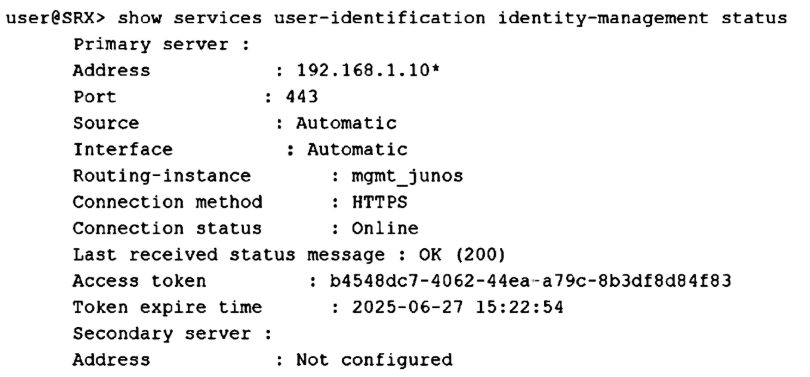
Referring to the exhibit, which two statements are correct? (Choose two.)
A. IP address 192.168.1.10 is the SRX Series device.
B. IP address 192.168.1.10 is the primary JIMS server.
C. The JIMS server to the domain controller connection is online.
D. The SRX Series device to the JIMS connection is online.
Explanation:
The output of the show services user-identification identity-management status command displays the connection status between the SRX Series device and the JIMS (Juniper Identity Management Service) server. The IP address 192.168.1.10 is configured as the primary JIMS server, not the SRX itself. The "Connection status: Online" field indicates that the SRX-to-JIMS connection is successfully established.
Correct Option:
B. IP address 192.168.1.10 is the primary JIMS server.
The output clearly shows the configured "Primary server" address as 192.168.1.10, and the "Connection method" is HTTPS, which is the protocol used by SRX to communicate with JIMS.
D. The SRX Series device to the JIMS connection is online.
The "Connection status" field explicitly states "Online" under the primary server section. Additionally, the "Last received status message: OK (200)" confirms that the HTTPS communication between the SRX and the JIMS server was successful.
Incorrect Option:
A. IP address 192.168.1.10 is the SRX Series device.
This is incorrect. The IP address listed under "Primary server" is the remote JIMS server, not the local SRX device. The SRX's own management IP would be displayed in other commands like show interfaces or show configuration.
C. The JIMS server to the domain controller connection is online.
The command output only shows the status of the SRX-to-JIMS connection. It does not display any information about the connection status between JIMS and any domain controllers. To verify that, you would need to check JIMS logs or its own management interface.
Reference:
Juniper Networks Documentation: show services user-identification identity-management status command for verifying JIMS connections
| Page 3 out of 9 Pages |